咧
Character Story & Explanation
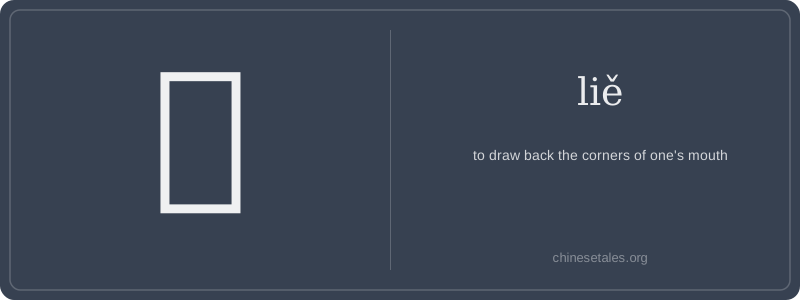
The earliest trace of 咧 appears not in oracle bones, but in early clerical script (lìshū), where it emerges as a clear compound: 口 (kǒu, 'mouth') on the left — unmistakably pictographic, like an open jaw — fused with 列 (liè, 'to arrange, line up') on the right. 列 itself evolved from a bronze script glyph showing a knife cutting through fabric — implying *separation* or *splitting*. So visually, 咧 is 'mouth + splitting': a mouth forcibly parted, lips drawn apart like fabric sliced down the middle. Its nine strokes crystallize this idea — the three horizontal lines in 列 mimic sharp, deliberate cuts across the oral aperture.
By the Tang and Song dynasties, 咧 was firmly entrenched in vernacular literature as a verb for exaggerated oral expression — especially in storytelling manuals and opera scripts, where performers needed precise terms for facial gestures. In the Ming novel Water Margin, characters '咧着嘴笑' (grin with mouths agape) to signal mockery or bravado, never quiet amusement. The character’s visual structure — mouth + 'cutting' — never strayed from its core idea: the mouth isn’t smiling; it’s *being opened*, stretched, or contorted — a subtle but powerful distinction that still echoes in modern spoken Mandarin.
At its heart, 咧 (liě) isn’t just ‘to smile’ — it’s the *unfolding* of a mouth: lips pulled wide, corners sharply drawn back in a grin, smirk, or grimace. It’s visceral and physical, emphasizing *motion* and *exaggeration*. You won’t find it in formal writing or polite speech; instead, it lives in vivid storytelling, dialect-heavy dialogue, and expressive narration — think of a storyteller widening their eyes and stretching their mouth as they say, 'He 咧开嘴,露出两排大牙!' ('He split his mouth open, revealing two rows of big teeth!').
Grammatically, 咧 almost always appears in the pattern 咧开 (liě kāi), meaning 'to part/split open (the mouth)', or as a final particle in northern dialects (e.g., '走咧!' — 'Let’s go!'), though that usage is pronounced *lie* (light tone) and unrelated to the mouth-meaning. Learners often mistakenly use it like 笑 (xiào) — but 咧 is never neutral or gentle; it’s always dynamic, slightly theatrical, and rarely used alone without a complement like 开 or 着.
Culturally, this character reveals how Chinese prioritizes *embodied expression*: meaning isn’t just in the emotion, but in the precise muscular gesture — the *direction*, *degree*, and *tension* of the mouth movement. A common error? Writing 咧 when you mean 列 (liè, 'to line up') or 洌 (liè, 'clear water') — homophones with totally different radicals and meanings. Also, don’t confuse it with 咧 as a dialect particle — that’s a grammatical ghost, not a semantic one!