咦
Character Story & Explanation
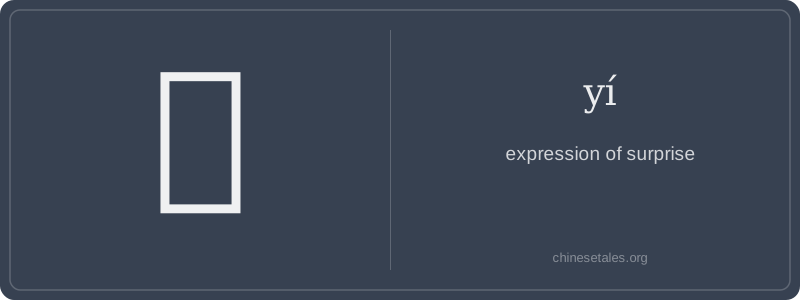
The earliest trace of 咦 appears not in oracle bones, but in late Warring States bamboo slips — where it emerges as a phonetic-semantic compound. Its left side 口 (kǒu, ‘mouth’) is the semantic radical, anchoring it firmly to speech and sound. The right side 宜 (yí, ‘suitable, proper’) serves as the phonetic component — its ancient pronunciation was nearly identical to modern yí, and its shape (a woman under a roof, suggesting harmonious domestic order) provided the sound clue. Over centuries, 宜 simplified visually: the ‘woman’ (女) fused with the ‘roof’ (宀) and ‘meat offering’ (月) elements, shrinking into the compact, angular form we see today — nine strokes total, with the final dot (丶) added as a distinct stroke marker for clarity.
This character didn’t exist in Classical Chinese as a standalone interjection — early texts used phrases like ‘怪哉’ (guài zāi, ‘how strange!’) instead. 咦 emerged organically in Song-Yuan vernacular literature and drama, reflecting how spoken language began shaping written expression. Its visual logic is elegant: mouth + ‘suitable’ — not because surprise is ‘suitable’, but because the sound *yí* was already associated with questioning tones, and 宜 offered the perfect phonetic scaffold. In Ming dynasty novels like ‘Jin Ping Mei’, 咦 bursts onto the page mid-dialogue, capturing the exact timbre of startled, conversational realism — a linguistic fossil of everyday Ming speech frozen in ink.
咦 (yí) isn’t a word with dictionary ‘meaning’ — it’s pure vocal punctuation, the Chinese equivalent of an eyebrow-raised ‘Huh?!’ or ‘Wait, what?!’ It carries no lexical weight, but immense pragmatic power: it signals sudden cognitive friction — a mismatch between expectation and reality. Think of it as your brain hitting ‘pause’ mid-thought. It’s never used alone as a complete sentence in formal writing, but in speech and dialogue-heavy texts (novels, subtitles, WeChat chats), it’s indispensable for authenticity.
Grammatically, 咦 functions as an interjection — always sentence-initial, always followed by a pause (often a comma or ellipsis). It can precede questions (咦?你今天不上班?), statements (咦,我的钥匙呢?), or even just trail off in disbelief (咦……). Crucially, it’s *not* a question particle like 吗 — it doesn’t grammatically turn a statement into a question; it merely flags the speaker’s surprise *before* the question or observation unfolds. Learners sometimes overuse it like English ‘um’ or insert it mid-sentence — a dead giveaway of non-native rhythm.
Culturally, 咦 conveys mild, non-confrontational bewilderment — think ‘polite confusion’, not anger or suspicion. It’s common in service interactions (a cashier noticing a discount wasn’t applied), classroom moments (a teacher spotting a clever mistake), or gentle teasing among friends. A classic pitfall: confusing it with written exclamations like 啊 (ā) or 哎 (āi), which carry different emotional registers (alarm vs. greeting vs. realization). 咦 is uniquely *intellectual surprise* — the sound of gears clicking, not stomach dropping.