咥
Character Story & Explanation
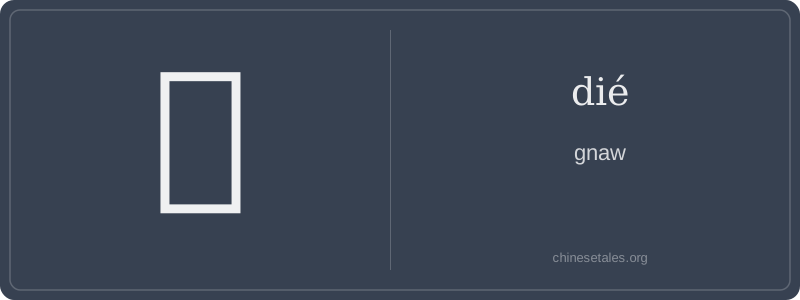
The earliest form of 咥 appears in bronze inscriptions as a combination of 口 (mouth) and 世 (shì, originally depicting three generations stacked — later simplified to 彐), but crucially, the top part evolved from a stylized depiction of *teeth biting down*. In oracle bone script, scholars reconstruct a variant showing jagged lines inside the mouth radical — unmistakably evoking sharp, interlocking teeth in motion. Over centuries, the upper component condensed into 彐 (a flat, claw-like shape), while 口 remained anchored at the bottom — preserving the core idea: oral action with mechanical force.
This visual logic held firm across dynasties. In the Shuōwén Jiězì (121 CE), Xu Shen defined it as 'to chew thoroughly; to gnaw repeatedly', citing its use in describing rodents damaging grain stores. By the Tang dynasty, poets employed it metaphorically: Li He wrote of 'sorrow gnawing the soul' (愁肠咥断), linking physical action to emotional erosion — a nuance still alive in modern literary Chinese. The character never softened; its sharp, compact form mirrors the relentless, focused action it names.
Think of 咥 (dié) as the 'chomping' character — not polite nibbling, but the gritty, persistent gnawing of teeth on tough material: wood, bone, or even stubborn problems. It’s visceral and physical, carrying a sense of effort, duration, and quiet intensity. Unlike common verbs like 吃 (chī, 'to eat') or 咬 (yǎo, 'to bite'), 咥 implies repeated, grinding action — imagine a rat gnawing through a sack, or time slowly gnawing away at resolve.
Grammatically, it’s almost always transitive and used in literary or descriptive contexts — rarely in casual speech. You’ll find it in compound verbs like 咥穿 (dié chuān, 'gnaw through') or as a standalone verb in vivid narration: '老鼠在暗处咥着木梁' ('Rats are gnawing the wooden beam in the dark'). Note: it’s never used for eating food socially — saying '我咥了饭' would sound bizarre or archaic. Learners sometimes overextend it like 吃; resist that urge!
Culturally, 咥 appears in classical texts to evoke decay, persistence, or quiet destruction — think of bamboo slips being eaten by insects, or sorrow ‘gnawing’ at the heart (a poetic trope). Its secondary reading xì is rare and mostly confined to ancient phonetic loan usages — you’ll almost never need it. The biggest trap? Confusing it with 易 (yì) or 迭 (dié, 'repeatedly') — they look similar, but 咥 is all about *mouth + teeth + motion*, not abstraction or repetition.