咣
Character Story & Explanation
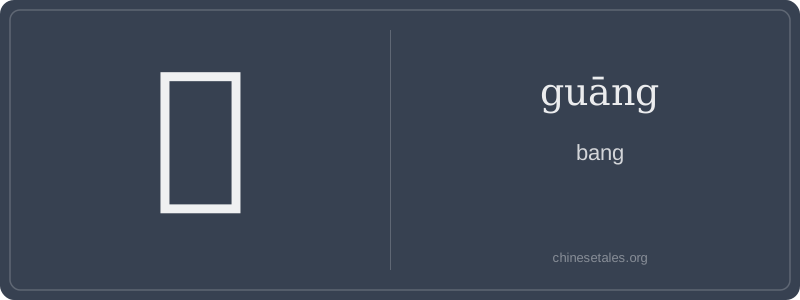
The earliest form of 咣 doesn’t appear in oracle bones — it’s a latecomer, born in the Ming–Qing vernacular era. Its structure is brilliantly literal: 口 (kǒu, ‘mouth’/‘sound’) on the left, and 光 (guāng, ‘light’) on the right — but here, 光 isn’t about illumination. In late imperial slang, 光 was used phonetically (a *phonetic loan*) to capture the guttural ‘gw-’ onset and open ‘-uang’ vowel of the onomatopoeia. Visually, the nine strokes flow downward like a heavy object dropping: the 口 sets the stage for sound, while 光’s three horizontal strokes (一 一 一) and vertical stroke (丨) mimic the sharp descent and reverberating tail of the noise itself.
Unlike ancient pictographs, 咣 emerged from street-level speech — first in storytellers’ scripts and later in Qing-era novels like Strange Tales from a Chinese Studio, where it punctuates sudden, jarring moments (a coffin lid slamming, a sword clanging into a stone well). Its meaning never shifted — it’s been purely onomatopoeic since inception — yet its visual pairing with 光 subtly reinforces cultural associations: light flashes *with* loud sounds (lightning/thunder), so even its ‘light’ component echoes perception, not semantics.
Imagine you’re in a Beijing hutong at midnight — suddenly, a heavy iron door slams shut: guāng! That’s 咣: not just any ‘bang’, but a deep, resonant, metallic *thud* with weight and finality. It’s an onomatopoeic character — pure sound captured in ink. Native speakers don’t use it alone; it only appears in reduplicated forms like 咣当 (guāng dāng) or embedded in vivid descriptive phrases. You’ll never see ‘I heard 咣’ — instead, it’s always part of a sensory cascade: 咣当一声,玻璃碎了 (guāng dāng yī shēng, bō li suì le) — ‘With a CLANG-SHATTER, the glass broke.’
Grammatically, 咣 is strictly interjectional and inseparable from its echo — it almost never stands solo in speech or writing. Learners sometimes try to use it like English ‘bang!’ as a standalone exclamation (e.g., ‘咣! The gun fired!’), but that’s unnatural. In Chinese, it needs rhythm and resonance: 咣当、咣啷、咣啷啷 — the repetition mimics acoustic decay. It’s also tone-sensitive: though written with first tone guāng, native speakers often stretch or drop the tone in fast speech for dramatic effect.
Culturally, 咣 carries urban grit — think subway doors, factory gates, old temple bells struck once at dusk. It’s absent from formal writing and poetry, reserved for spoken storytelling, comic books, and dialect-rich fiction (especially Northern Mandarin). A common mistake? Confusing it with 轰 (hōng) — which implies sustained noise (like thunder or engines), while 咣 is sharp, singular, and percussive. Also, never write 咣 without context: it’s a sonic brushstroke, not a noun or verb.