咠
Character Story & Explanation
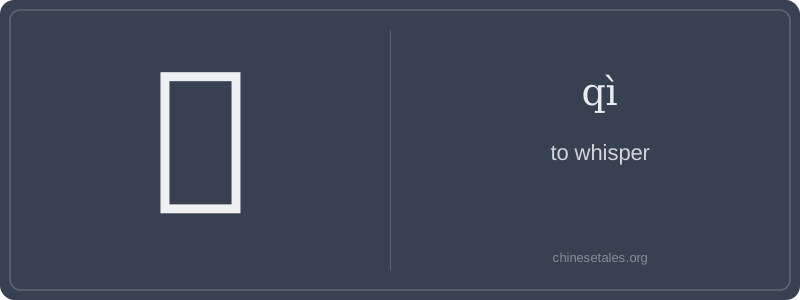
The earliest known form of 咠 appears on Han dynasty bamboo slips, not oracle bones — and it’s a brilliant stroke-level pun. It combines 口 (mouth) on the left with 乞 (qǐ) on the right, which itself evolved from a pictograph of a person kneeling with arms raised, begging. In early clerical script, the 乞 side was drawn with three short, descending strokes — mimicking faint, fading breaths — while the mouth radical anchored the action to speech. By the Tang dynasty, standardization smoothed the lines, but the visual echo remained: tiny, downward strokes = quiet, vanishing sound.
Over time, 咠’s meaning sharpened from general ‘soft speech’ to specifically ‘whispering’ — especially secretive or furtive speech. It appears in Tang poet Li He’s ghostly verses and Ming-dynasty vernacular tales where spirits ‘qì’ warnings into mortal ears. Interestingly, its visual structure reinforces its semantics: the three strokes of 乞 look like three whispered syllables dissolving — not loud, not clear, but intentional, intimate, and fleeting. That breathy fragility is baked into every stroke.
Think of 咠 (qì) as the Chinese equivalent of leaning in, cupping your hand beside someone’s ear, and letting breath become sound — it’s not shouting, not speaking normally, but that intimate, hushed, almost conspiratorial whisper where meaning hangs in the air like mist. The ‘mouth’ radical (口) tells you instantly this is about vocalization, while the right side, 乞 (qǐ), isn’t just phonetic decoration: its ancient form meant ‘to beg’ or ‘to plead’, evoking the quiet urgency of a plea — soft but loaded with intent.
Grammatically, 咠 is rare in modern spoken Mandarin and appears mostly in literary, poetic, or classical-style contexts — never in everyday chit-chat. You’ll find it as a verb (often reduplicated: 咠咠) or in fixed compounds like 咠语. It’s *not* used in casual commands (‘whisper to me!’) — that’s usually 低声说 or 耳语 instead. Learners mistakenly try to substitute it for 耳语 or 低语, but 咠 carries a distinct aesthetic weight: it’s quieter, more secretive, sometimes even eerie — like whispers in an old temple corridor.
Culturally, 咠 often appears in classical poetry and ghost stories, where whispered words blur the line between human speech and spectral murmurs. A common mistake? Overusing it — it’s not a neutral synonym for ‘to whisper’. Its rarity means using it incorrectly sounds archaic or unnatural, like saying ‘prithee’ in a Zoom meeting. If you hear it, pause: something delicate, urgent, or uncanny is happening.