咚
Character Story & Explanation
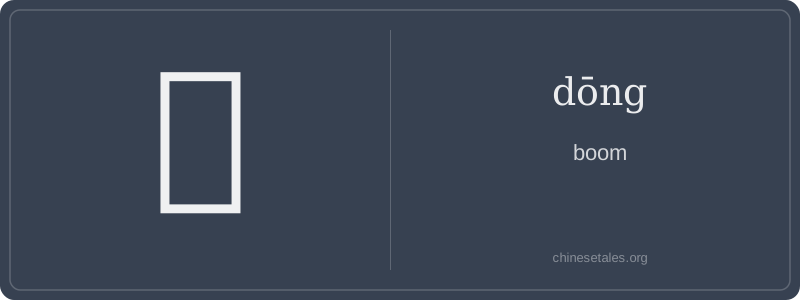
The character 咚 has no ancient oracle bone or bronze script form — it’s a latecomer, born in the late imperial or early modern era as Chinese writing expanded to capture colloquial speech and sound effects. Its structure is brilliantly transparent: left side 口 (kǒu, ‘mouth’ or ‘speech radical’) signals it’s a vocalized sound; right side 冬 (dōng, ‘winter’) provides both phonetic clue and visual heft — its dense, layered strokes (点、横、撇、捺, plus the ‘ice’ radical 冫) evoke something heavy dropping, freezing mid-air, then echoing downward. The eight strokes build rhythmically: first the mouth frame, then the winter component’s descending strokes mimic sound waves rippling outward.
Historically, 咚 appears earliest in Qing-dynasty vernacular fiction and early 20th-century illustrated storybooks, where writers needed vivid auditory texture. Unlike classical characters tied to philosophy or ritual, 咚 emerged from performance culture — puppet theater scripts, folk storytelling, and later, comic strips. Its ‘winter’ component isn’t semantic (no link to cold), but phonetic reinforcement: 冬 was already pronounced dōng, making it the perfect scaffold for this booming sound. Visually, the compactness of 口 + 冬 mirrors how a sharp, round ‘boom’ feels contained yet explosive — like a drumhead snapping taut before release.
Imagine you’re watching a wuxia film: the hero leaps onto a temple bell, strikes it once — dōng! — and the sound vibrates through your chest. That’s 咚 in action: not just ‘boom’, but a deep, resonant, single percussive impact with physical weight and dramatic timing. It’s purely onomatopoeic — no abstract meaning, no verb conjugation, no noun function. It exists only to echo a sound, like English ‘thump’ or ‘clang’, but with distinctly Chinese rhythm and tonal punch.
Grammatically, 咚 is almost always used as an interjection or reduplicated for emphasis (咚咚), and it frequently appears in narrative prose or children’s books to punctuate action: ‘He kicked the door — dōng!’ It’s never used alone as a sentence; it needs context — usually paired with verbs like 敲 (to knock), 踢 (to kick), or 心跳 (heartbeat). Learners sometimes mistakenly treat it like a verb (e.g., *‘I dōng the drum’*), but it’s strictly a sound-effect word — like writing ‘BAM!’ in English comics. You don’t *do* 咚; you *hear* it.
Culturally, 咚 carries theatrical flair — think of Peking opera gongs, temple bells at dawn, or cartoonish ‘door-slam’ moments in animated shorts. It’s rarely used in formal writing, and never in academic or bureaucratic contexts. A common mistake is overusing it in spoken Chinese; native speakers deploy it sparingly for comedic or vivid effect — too many 咚s sound childish or melodramatic. Also, note: it’s tone 1 (dōng), not dōng like ‘east’ (东), though they share pronunciation — a coincidence, not a cognate.