咗
Character Story & Explanation
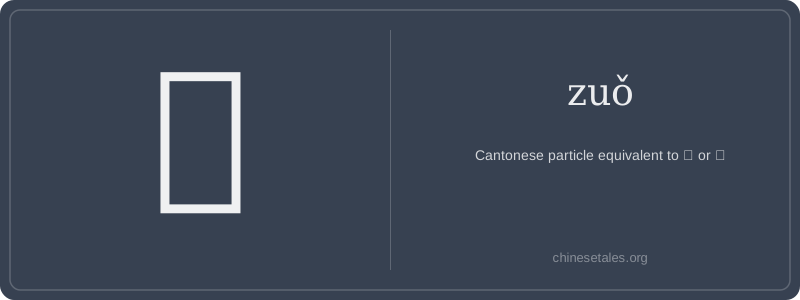
There is no oracle bone or bronze script for 咗 — because it didn’t exist until the late Qing dynasty, when Cantonese speakers needed a quick way to write the common final particle /zo²/ in informal texts. It emerged not from ancient pictographs but from cursive handwriting of the character 過 (guò, ‘to pass’), whose right-hand component 走 (zǒu, ‘to walk’) was repeatedly simplified in daily notes until only its lower part — the ‘stepping legs’ radical ⻊ — remained, then further stylized into the squiggle we now call 咗. No stroke count? Because it’s not built — it’s *eroded*, like a river carving stone through sheer repetition.
This visual reduction mirrors its semantic shift: 過 meant ‘to pass/experience’, but in rapid speech, its pronunciation softened to /zo²/, and its meaning narrowed exclusively to perfective aspect — shedding all other senses. By the 1930s, it appeared in early Cantonese novels and opera scripts as a standardized shorthand. Crucially, its form bears *no* relation to its meaning — it’s purely phonetic, a rebel among logographs. That’s why scholars call it a ‘phonogram’: a sound wearing borrowed clothes, not a picture telling a story.
Here’s the truth no textbook tells you: 咗 isn’t a ‘real’ character in the classical sense — it’s a Cantonese phonetic loan, born from spoken urgency. Its core function is grammatical, not lexical: it marks completed action (like Mandarin 了) or past experience (like Mandarin 過), but with a distinctly colloquial, down-to-earth rhythm. Think of it as the verbal equivalent of a satisfied sigh after finishing chores — not fancy, but deeply functional.
Grammatically, 咗 always clings to the verb it modifies — never stands alone, never appears in formal writing. Say ‘I ate’? In Cantonese: 我食咗 (ngo6 sik6 zo2). Notice how 咗 glues itself right after the verb, no space, no fuss. Unlike Mandarin 了, which can appear sentence-finally for change-of-state, 咗 stays tightly bound to the verb and *only* signals completion or experience — no ambiguity. Learners often misplace it (e.g., saying 我咗食) or overgeneralize it into Mandarin contexts — a classic ‘Cantonese-in-Mandarin’ slip that instantly flags you as a non-native speaker.
Culturally, 咗 is the quiet heartbeat of Hong Kong street talk, TV dramas, and WhatsApp chats — it’s unpretentious, fast, and fiercely local. You’ll never find it in government documents or newspaper headlines (those use standard written Chinese), but hear it everywhere in dai pai dongs and MTR stations. Its ‘zero strokes’ status? Not laziness — it’s a linguistic fossil: a pure sound symbol, stripped of etymology, preserved only because it *works*. That’s Cantonese pragmatism in one squiggle.