咕
Character Story & Explanation
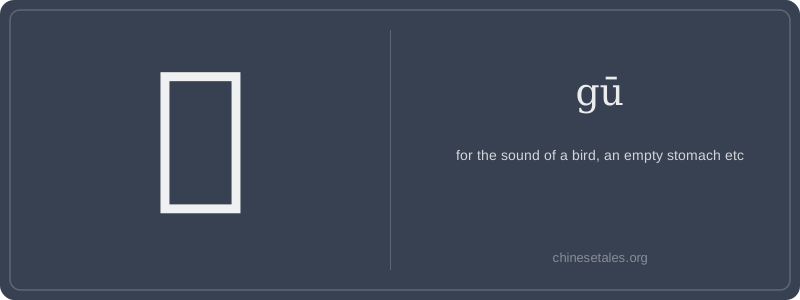
The earliest form of 咕 appears not in oracle bones but in early seal script (c. 3rd century BCE), where it combines 口 (kǒu, ‘mouth’) on the left with 古 (gǔ, ‘ancient’) on the right—a phono-semantic compound. The 口 radical signals speech or sound production, while 古 serves purely as a sound clue (both 咕 and 古 share the gū/gǔ root syllable). Visually, the modern 咕 retains this clean left–right split: eight strokes total—three for 口 (vertical, horizontal-fold, closing hook), five for 古 (horizontal, vertical, horizontal, dot, final stroke down-right). No pictographic bird or belly here—just elegant phonetic engineering.
Historically, 咕 emerged late—absent in classical texts like the Analects or Dao De Jing—but flourished in Ming and Qing vernacular fiction, where writers needed expressive, colloquial sound words for dialogue and atmosphere. In The Plum in the Golden Vase, servants ‘gū nong’ (咕哝) under their breath; in folk songs, pigeons ‘gū gū’ at dusk. Its visual simplicity (just mouth + ancient) belies its auditory sophistication: the ‘ancient’ component hints that this sound feels timeless, instinctive—older than language itself. Even today, when a child points and says ‘gū gū!’, they’re echoing a sonic tradition over 2,000 years old.
Imagine you’re sitting in a quiet Beijing courtyard at dawn—just as the first sparrows stir. Suddenly: gū… gū…—a soft, low, throaty coo from a pigeon on the eaves. That’s 咕 in action: not a word with dictionary ‘meaning’ like ‘bird’, but a pure sonic snapshot—a phonetic glyph capturing the very vibration of sound itself. In Chinese, 咕 isn’t used alone as a noun or verb; it’s almost always part of reduplicated onomatopoeic phrases like 咕咕 (gū gū) or embedded in compound verbs like 咕哝 (gū nong, ‘to mutter’). It’s visceral, bodily, and slightly intimate—the same sound your stomach makes when growling with hunger (肚子咕咕叫, dùzi gū gū jiào), or a baby’s gentle gurgle.
Grammatically, 咕 rarely stands solo. You’ll hear it in expressive, rhythmic pairs (咕咕, 咕噜, 咕哝) that mimic rhythm and timbre—not precise pitch. Learners often mistakenly treat it like a verb (‘to coo’) and try to conjugate it (e.g., *咕了, *咕过), but it doesn’t take aspect particles. Instead, it functions like English ‘coo-coo’ or ‘gurgle’: best used in vivid descriptions, children’s books, or dialogue tags (他咕哝了一句, tā gū nong le yī jù—‘He muttered something’). Its power lies in texture, not tense.
Culturally, 咕 carries gentle, unthreatening connotations—never harsh or alarming (unlike 啪 pā or 咚 dōng). It’s associated with vulnerability: hungry babies, nesting doves, lonely elders murmuring to themselves. A common mistake? Overusing it in formal writing—it’s conversational, literary, or poetic, never bureaucratic. Also, don’t confuse it with other mouth-radical sounds: 咕 is low-pitched and sustained, while 哗 huā is loud and rushing, and 嘀 dī is sharp and ticking.