咒
Character Story & Explanation
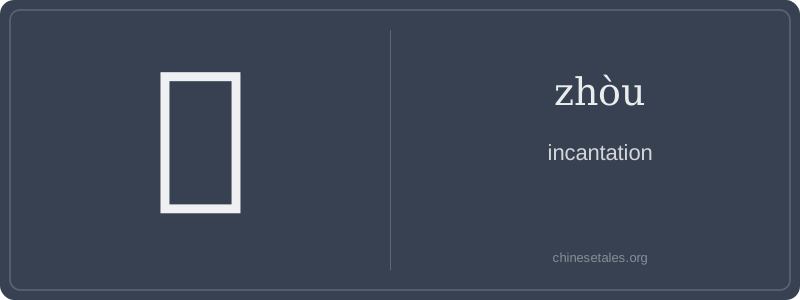
The earliest form of 咒 appears in Warring States bamboo slips — not as a pictograph, but as a phonosemantic compound already: 口 (kǒu, 'mouth') on the left, and 兆 (zhào, 'omen; crack pattern') on the right. 兆 originally depicted divination cracks on oracle bones — those mysterious, branching fissures that priests interpreted as heaven’s will. Over centuries, the 兆 component simplified: its top stroke curved, the two lower strokes shortened and angled inward, becoming today’s compact, angular right-hand side — eight strokes total, each echoing the sharp, decisive lines of a ritual utterance.
This visual fusion — mouth + omen — perfectly captures ancient Chinese cosmology: speech wasn’t just communication, but *cosmic intervention*. To speak a 咒 was to align human breath with celestial patterns, making language itself a form of divination. In the *Zhuangzi*, sages ‘chant odes to harmonize qi’ — precursors to later Daoist incantations. By the Tang dynasty, Buddhist mantras (like 唵嘛呢叭咪吽) were routinely called 咒语, merging Indian mantra practice with China’s native belief in spoken omens. Even today, the character’s shape whispers its origin: a mouth opening not to chat, but to crack open reality.
At its heart, 咒 (zhòu) isn’t just ‘incantation’ — it’s the *spoken power* of words made dangerous or sacred. Think of it as linguistic electricity: harmless syllables until channeled with intent — to curse, heal, bind, or awaken. Unlike generic terms like 话 (huà, 'speech') or 语言 (yǔyán, 'language'), 咒 implies ritual weight, secrecy, and consequence. You’ll almost never say ‘I’m learning a 咒’ casually — it’s reserved for spells in folklore, Taoist rituals, or fantasy novels (e.g., 魔法咒语 mófǎ zhòuyǔ, 'magic incantations').
Grammatically, 咒 is nearly always a noun — never a verb. You don’t ‘zhòu someone’; you recite a 咒 (念咒 niàn zhòu), break a 咒 (破咒 pò zhòu), or fall under a 咒 (中咒 zhòng zhòu). Crucially, it’s rarely used alone: it appears in compounds like 咒语 (zhòuyǔ, 'spell-words') or 咒文 (zhòuwén, 'incantation script'). Learners often mistakenly treat it like a verb or overuse it in modern speech — but in real life, even native speakers say ‘cursed’ as 被诅咒 (bèi zǔzhòu), not 被咒 (bèi zhòu).
Culturally, 咒 carries deep ambivalence: in Daoist texts, it’s divine protection; in folk tales, it’s witchcraft that backfires. The character’s mouth radical (口) reminds us — this power lives only when spoken aloud. A silent 咒 is no 咒 at all. That’s why you’ll see it paired with verbs like 吟 (yín, 'to chant') or 诵 (sòng, 'to recite'), never with writing verbs like 写 (xiě). Remember: if it’s written down without being uttered, it’s probably 符 (fú, 'talismans') — not 咒.