咑
Character Story & Explanation
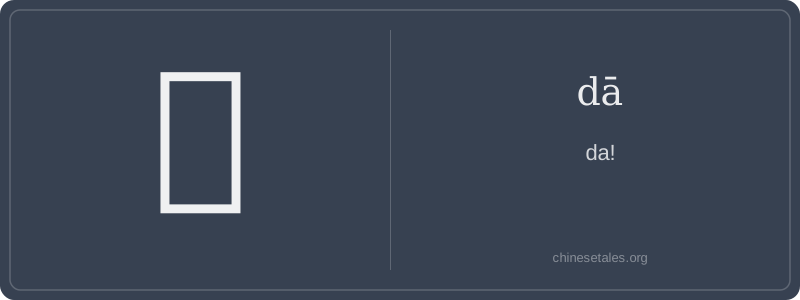
The character 咑 has no oracle bone or bronze script ancestry — it’s a modern coinage, likely emerging in late Qing or early Republican era print culture. Its form is deliberately constructed: 口 (mouth radical) on the left, and 丁 (dīng, 'nail' or 'male adult') on the right — not as semantic components, but as phonetic scaffolding. The 丁 provides the 'dā' sound (via historical phonetic borrowing: 丁 was once pronounced closer to *teng* or *ting*, but in regional folk pronunciation, it softened to 'da' in emphatic exclamations). Visually, the eight strokes balance compactness and impact: three horizontal lines in 口 (lips), two verticals and a hook in 丁 — together evoking a mouth snapping shut with a percussive 'da!'
This character never appears in classical texts. It first surfaced in Shanghai ‘manhua’ (comic) magazines of the 1920s–30s, where artists needed a written representation for abrupt, non-lexical vocal bursts — much like English comics use 'BLAM!' or 'YOW!'. Its meaning didn’t evolve from ancient roots; it was invented whole-cloth to fill a typographic gap. Yet its design obeys classical logic: 口 signals voice, 丁 suggests sharpness and finality (a nail driven home), and the total stroke count — eight — subtly echoes the auspicious, 'complete' number in folk numerology, reinforcing its role as a self-contained, decisive utterance.
Think of 咑 not as a 'word' but as a sonic burst — the Chinese equivalent of an English interjection like 'DA!' or 'HEY!' shouted with sudden surprise, mock authority, or playful emphasis. It’s not a verb, noun, or adjective; it’s pure vocal punctuation. You’ll never find it in formal writing or textbooks because it lives entirely in spoken, performative, or comic contexts — think cartoon speech bubbles, stage directions in traditional opera scripts, or a parent pretending to be a stern general while tickling a child.
Grammatically, 咑 stands alone: no particles, no modifiers, no tense. It’s always sentence-initial and followed by a pause (or an exclamation mark). You’d never say 'I 咑 you' — it doesn’t take objects. Instead, it functions like a theatrical drumbeat: Dā! — then action follows. Learners sometimes mistakenly treat it like a verb ('He dā-ed the door!'), but that’s impossible — it has zero conjugation, zero derivation, and zero dictionary entry in standard Mandarin dictionaries. Its power lies precisely in its grammatical emptiness.
Culturally, 咑 is a linguistic wink — a conscious, stylized exaggeration of vocal onset. It echoes the 'dā' sound made when sharply closing the mouth (like a quick 'da' with clipped breath), mirroring how 口 radicals often encode mouth-related sounds or actions. Western learners often overuse it, thinking it’s 'cute' or 'funny' — but native speakers reserve it for deliberate caricature, satire, or affectionate teasing. Misplacing it (e.g., in a job interview) would feel like shouting 'BOO!' at a funeral: technically correct sound, catastrophically wrong register.