咎
Character Story & Explanation
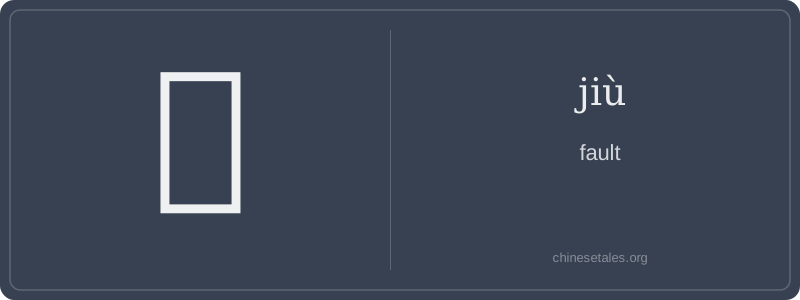
The earliest form of 咎 appears on Shang dynasty oracle bones as a composite glyph: a mouth (口) atop a kneeling figure (, an early form of 人) holding something resembling a broken ritual vessel — possibly a cracked bronze ding (鼎). The mouth wasn’t for speaking, but for *proclaiming judgment*: the ruler or shaman declaring fault after divination revealed a ritual misstep. Over centuries, the kneeling figure simplified into the upper component 旡 (jì), which itself evolved from a stylized person with head bowed — signifying submission to blame. By the Qin seal script, the shape stabilized: 口 (mouth/judgment) + 旡 (kneeling, culpable person), forming the modern 8-stroke structure.
This visual logic held firm through history: the mouth pronounces the verdict; the bowed figure accepts it. In the *Zuo Zhuan* (c. 4th c. BCE), 咎 appears repeatedly in contexts of political failure — e.g., '君之咎也' ('this is the ruler’s fault') — where fault implies breach of cosmic or feudal order, not mere error. Even today, its stroke order reinforces its gravity: the final downward stroke of 旡 (stroke #8) lands like a gavel — decisive, irreversible, and heavy with consequence.
At its core, 咎 (jiù) isn’t just ‘fault’ — it’s *blameworthy fault*, the kind that carries moral weight, consequence, or even cosmic retribution. Think less 'oops I spilled coffee' and more 'you broke the ritual vessel before the ancestral sacrifice'. It’s formal, literary, and almost always appears in contexts of responsibility, accusation, or divine justice — never casual slang. You’ll rarely hear it in spoken Mandarin today; it lives in classical texts, legal documents, and solemn expressions like 自取其咎 (zì qǔ qí jiù, 'to bring trouble upon oneself').
Grammatically, 咎 functions primarily as a noun ('fault', 'guilt'), but crucially, it can also be a verb meaning 'to blame' — though only in highly fixed, literary constructions like 咎某人 (jiù mǒu rén, 'to blame someone'). Unlike common verbs like 责备 (zébèi), 咎 doesn’t take aspect particles (no 咎了, no 正在咎). Learners often mistakenly try to use it like a modern verb — big red flag! Also, it never stands alone as a predicate: you say 他有咎 (tā yǒu jiù, 'he bears guilt'), not *他咎.
Culturally, 咎 resonates with ancient Chinese ideas of moral causality — if disaster strikes, someone *must* have incurred 咎. Confucius warned against shifting blame (《论语》: '不迁怒,不贰过' — 'do not transfer anger; do not repeat the same fault'), implicitly acknowledging 咎 as personal, inescapable, and ethically charged. A common learner trap is overusing it in speech or confusing it with simpler words like 错 (cuò) or 过错 (guòcuò); this instantly sounds archaic or sarcastically dramatic — like quoting Shakespeare while ordering dumplings.