咈
Character Story & Explanation
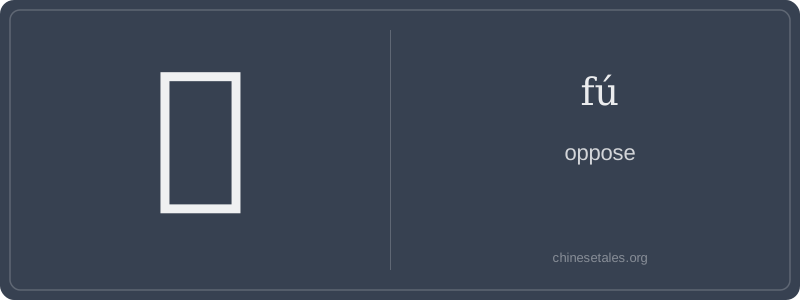
The earliest form of 咈 appears in late Warring States bamboo slips — not as a pictograph, but as a phono-semantic compound: the left side 口 (kǒu, 'mouth') signals speech-related meaning, while the right side 弗 (fú) acts as both sound clue and semantic amplifier. 弗 itself evolved from an oracle bone glyph depicting a bent rod piercing through a cloth bundle — symbolizing 'to obstruct' or 'to negate.' Over centuries, 弗 simplified into its current shape: two horizontal strokes crossing a vertical line with a hook — visually echoing suppression or forceful interruption.
By the Han dynasty, 咈 had crystallized as a literary term for principled refusal, especially in official or ethical contexts. It appears in the Han Shu (Book of Han) describing ministers who 'fú zhào' (opposed imperial edicts they deemed unjust), framing dissent as duty rather than rebellion. The mouth radical reinforces that this opposition is voiced, deliberate, and public — not silent resentment. Its visual structure — mouth + obstruction — remains a perfect microcosm: speech actively blocking what is wrong.
Think of 咈 (fú) not as a common verb like 'oppose' in English, but as a literary, almost ceremonial word — the kind you’d find carved on a bronze vessel or quoted by a Ming-dynasty scholar to signal solemn, principled resistance. It doesn’t mean 'I disagree with your lunch order'; it means 'I reject this decree on moral grounds.' Its tone is weighty, formal, and slightly archaic — like saying 'forsooth' instead of 'really.' You’ll rarely hear it in spoken Mandarin, but you’ll see it in classical allusions, political essays, or historical dramas where characters uphold righteousness against tyranny.
Grammatically, 咈 functions almost exclusively as a transitive verb, always taking a direct object — usually an abstract noun: 咈命 (fú mìng, 'oppose an order'), 咈理 (fú lǐ, 'go against reason'). It never stands alone ('He 咈s' is ungrammatical); it needs that object to anchor its gravity. Learners often misapply it like modern verbs (e.g., *wǒ fú tā — 'I oppose him'), but that’s incorrect — it opposes ideas, mandates, or principles, not people directly.
Culturally, 咈 carries Confucian resonance: it implies dissent rooted in virtue, not ego. Mistaking it for casual disagreement risks sounding pompous or anachronistic. Also, watch your tone — mispronouncing fú as fǔ (third tone) changes nothing phonetically in isolation, but in compounds like 咈然 (fú rán), the first tone signals deliberate, unwavering rejection — a nuance lost if you slip. This isn’t a vocabulary item to drop into HSK-3 convos; it’s a brushstroke in the calligraphy of classical Chinese thought.