咇
Character Story & Explanation
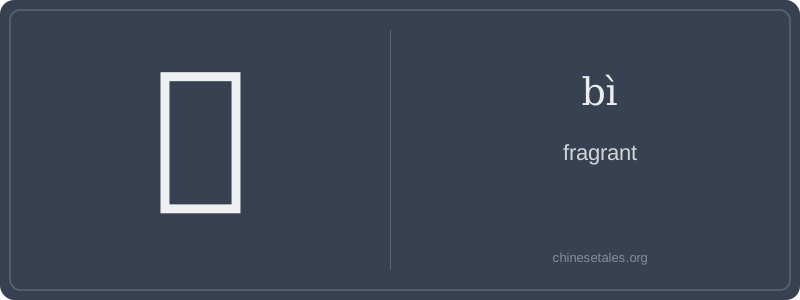
Zoom back 3,000 years: the earliest form of 咇 appears in late Shang oracle bone inscriptions as a stylized depiction of steam rising from a vessel containing aromatic herbs — not just any steam, but the thin, spiraling vapor released during ritual fumigation. The top element resembled rising vapor (later evolving into the 'bì' phonetic component 口 + 必), while the lower part suggested a covered cauldron or sacrificial tripod. Over centuries, the cauldron shape simplified into the radical 口 (mouth), and the vapor became the phonetic 必 — a brilliant case of sound borrowing masking original pictorial logic.
By the Warring States period, 咇 had crystallized into its current form, shedding its literal vessel but retaining its sacred aura. It appears in the Chu Ci (Songs of Chu), where Qu Yuan writes of '咇馞满庭' — fragrant vapors filling the courtyard during shamanic rites. Later, in Tang poetry, it was used almost exclusively in compounds to elevate sensory description beyond mere smell into spiritual resonance. Its visual minimalism (just 口 + 必) belies its heavy ritual weight — a perfect example of how Chinese characters compress cosmology into strokes.
Let’s be honest: 咇 (bì) is a ghost character — elegant, ancient, and practically extinct in modern speech. It means 'fragrant', yes, but not the everyday kind you’d use for perfume or jasmine tea. Think of it as poetic incense smoke curling from a Song dynasty altar — rare, reverent, and reserved for classical poetry, ritual texts, or literary affectation. You won’t hear it in HSK dialogues or street food stalls; it’s the linguistic equivalent of a lacquered scholar’s brush, not a smartphone emoji.
Grammatically, 咇 functions like an adjective, but unlike common words like 香 (xiāng), it almost never stands alone. It appears embedded in compound words (like 咇馧 or 咇馞) or as part of parallel four-character phrases in classical prose — often paired with other scent-related characters to intensify aroma imagery. Learners mistakenly try to substitute it for 香 in casual sentences (e.g., *这个花很咇*), but that sounds like quoting Confucius at a bubble tea shop — charming, but deeply out of place.
Culturally, 咇 carries olfactory solemnity: it evokes ancestral reverence, Buddhist sutra chanting, or Tang poets describing temple gardens at dawn. Its near-total absence from spoken Mandarin means learners rarely encounter it outside dictionaries or calligraphy scrolls — which is why mispronouncing it as 'bī' (flat tone) or confusing it with 碧 (jade-green) is so common. Remember: this isn’t vocabulary — it’s verbal incense. Burn it sparingly, and only with intention.