咆
Character Story & Explanation
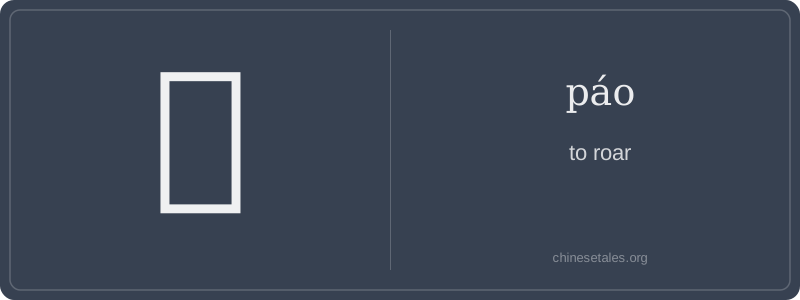
The earliest form of 咆 appears in seal script as a combination of 口 (mouth) and 包 (to wrap/enclose)—but not as we’d expect. In oracle bone inscriptions, the ‘包’ part wasn’t yet standardized; it resembled a swollen, rounded shape enclosing something vital—perhaps lungs, breath, or raw sound itself. Over centuries, the top stroke of 包 simplified into the horizontal line, the curved strokes tightened into the modern ‘勹 + 己’ shape, and the 口 radical anchored it firmly as a vocal act. By the Han dynasty, the character had settled into its current 8-stroke form: three strokes for 口, five for 包—each stroke echoing the compression and explosive release of a roar.
This visual logic mirrors its semantic evolution: from depicting breath held tight inside the chest (the ‘wrapping’ sense of 包) to the sudden, violent expulsion of sound. In the *Zuo Zhuan*, 咆 appears in descriptions of battlefield chaos—‘the horses 咆, the drums shook the earth’. Later, poets like Du Fu used 咆哮 to personify nature’s wrath, cementing its association with unrestrained, awe-inspiring force. The mouth doesn’t speak here—it *unleashes*.
Think of 咆 (páo) as the Chinese equivalent of a lion’s roar in a Hollywood movie—deep, guttural, and impossible to ignore. Unlike English ‘roar’, which can be metaphorical (‘roar with laughter’), 咆 is almost exclusively reserved for fierce, animalistic, or thunderous vocalization: lions, tigers, crashing waves, or even a furious general bellowing orders. It’s not used for human speech like ‘shouting’ (喊 hǎn) or ‘yelling’ (叫 jiào)—that’s a common learner mistake. You won’t hear someone 咆 at their coffee order; you *will* hear a tiger 咆 in a Tang dynasty poem or a storm 咆 across a mountain pass.
Grammatically, 咆 is nearly always a verb, and it loves reduplication: 咆哮 (páoxiāo) is far more common than standalone 咆. It rarely appears alone in modern prose—think of it like the word ‘bellow’ in English: precise, literary, and slightly dramatic. In sentences, it’s often paired with onomatopoeic intensifiers or natural subjects: ‘the wind 咆哮’, ‘the sea 咆哮’. No object needed—it’s inherently intransitive and self-contained.
Culturally, 咆 carries a legacy of untamed power and primal authority. In classical texts, it evokes cosmic force—not just noise, but a challenge to order. Learners sometimes misread it as ‘pào’ (like 炮 ‘cannon’) due to the ‘包’ component, but the tone and meaning are worlds apart. And no—despite its mouth radical (口), it’s *not* about talking. It’s about the body vibrating before words even form.