咅
Character Story & Explanation
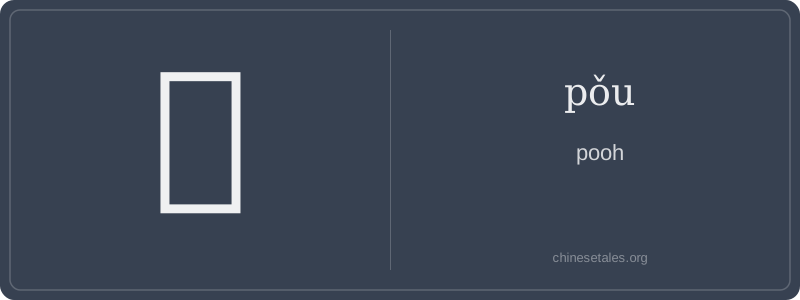
The earliest form of 咅 appears in late Warring States bamboo slips as a stylized mouth (口) with a simplified 'hand' or 'breath' element above — not a full hand, but three quick strokes suggesting exhalation: 丿丿一. Over time, the upper part condensed into the distinctive 甫 shape (fǔ), which originally meant 'beginning' or 'bud' but here was borrowed purely for sound. By the Han dynasty, the character stabilized into 口 + 甫 — eight strokes total, with the mouth radical anchoring its vocal nature and 甫 providing phonetic scaffolding (though pronunciation shifted from fǔ to pǒu).
This shift from 'bud' to 'pooh!' reflects ancient Chinese phonetic borrowing at its most whimsical: scribes chose 甫 because its early pronunciation *puʔ* approximated the guttural puff of dismissal. The character appears in the 3rd-century dictionary Guangyun labeled as 'sound of contemptuous exhaling', and Tang poets used it in satirical verses to mock pedantic scholars. Visually, the mouth (口) opens downward — like lips parting for a dismissive 'pffft' — while 甫’s top stroke curves like an eyebrow arched in skepticism.
Imagine hearing a cartoonish, dismissive 'pǒu!' — like blowing air through your lips to show impatience or disbelief. That’s 咅 in a nutshell: an onomatopoeic interjection capturing a sharp, breathy expulsion of air. It’s not a verb, noun, or adjective — it’s pure sound made visible. Unlike common interjections like 啊 (ā) or 哎 (āi), 咅 is rare, literary, and almost theatrical; you’ll find it more in classical satire or modern parody than in daily speech. Think of it as Chinese ‘pooh!’ — not the Winnie-the-Pooh kind, but the aristocratic sniff of disdain.
Grammatically, 咅 functions exclusively as an exclamatory particle — always standing alone or at the start of a sentence, never modified or conjugated. You won’t say *wǒ pǒu* or *pǒu le*. Instead, it appears like this: Pǒu! Nǐ yě xìn zhè ge? ('Pooh! You believe that too?'). Its tone (third tone) matters: pǒu carries weight and irony — never light or playful like pōu (which means 'to split') or pōu (a different character entirely). Learners often misread it as pōu or pōu due to visual similarity, but its meaning collapses without that precise 'uh-oh' breathiness.
Culturally, 咅 is a linguistic fossil — preserved in dictionaries and classical glosses but rarely uttered aloud today. It appears in Ming-Qing vernacular fiction to punctuate mockery, and sometimes in modern essays quoting old texts. A common mistake is overusing it thinking it’s 'cool slang'; in reality, deploying 咅 unironically may sound archaic or comically pretentious. Its power lies in restraint: one well-placed 咅 can undercut an entire argument — like dropping a single, perfectly timed spit-take in print.