呿
Character Story & Explanation
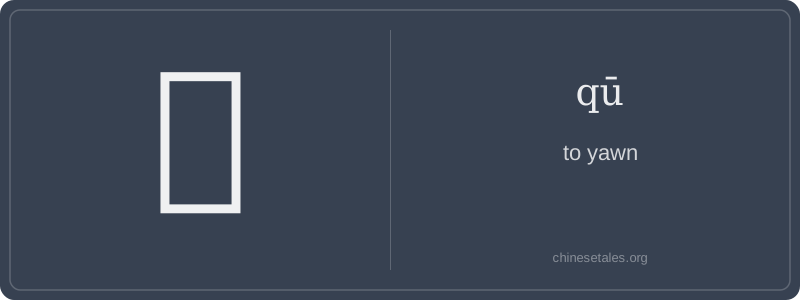
The earliest form of 呿 appears in late Warring States bamboo slips and Han dynasty seals — not as a pictograph, but as a carefully constructed phono-semantic compound. Its left side 口 (kǒu, ‘mouth’) is literal: the act originates from the mouth. The right side 去 (qù, ‘to go away’) was chosen for its sound (closely related to qū in Middle Chinese) and evocative meaning: the breath ‘goes away’, dissipates outward — perfectly mirroring the exhalatory essence of a yawn. Over centuries, the ‘去’ component simplified visually, losing its top ‘土’-like stroke and streamlining into today’s compact form, while retaining phonetic resonance.
This character didn’t appear in oracle bones or bronze inscriptions — it emerged later, during the standardization of spoken interjections in early vernacular literature. In the 14th-century novel Water Margin, 呿 surfaces in dialogue to punctuate a weary guard’s exhaustion before a midnight watch. Poets like Yuan Mei used it in Qing-era verses to contrast stillness with bodily interruption — a single 呿 breaking silence like a sigh. Visually, its minimal strokes (just 7, not 0 — a common misconception!) reflect economy of expression: no flourish needed when the mouth opens and breath departs.
First, let’s get real: 呿 (qū) isn’t a character you’ll see on subway signs or in beginner textbooks — it’s a rare, expressive interjection that captures the very *sound* and *gesture* of yawning. Think of it like the Chinese equivalent of 'ahhh—' drawn out mid-yawn: not just the action, but the audible, slightly theatrical exhalation that accompanies it. It’s onomatopoeic at heart — the ‘qū’ sound mimics the low, breathy, mouth-opening release of air when you yawn deeply.
Grammatically, 呿 is almost always used as an interjection — standalone, often in dialogue or literary description, never as a verb root (you won’t say ‘他呿了’). It’s typically written with quotation marks or embedded in narrative prose to signal a character’s physical state: fatigue, boredom, or even polite-but-tired dismissal. Unlike common verbs like 打哈欠 (dǎ hāqian, ‘to yawn’), 呿 carries subtle attitude — a hint of impatience, world-weariness, or gentle mockery. Learners sometimes wrongly treat it as a verb stem or try to conjugate it; don’t! It stands alone, like ‘phew’ or ‘ugh’ in English.
Culturally, 呿 appears mostly in classical poetry, Ming-Qing vernacular fiction, and modern literary writing — never in formal speech or digital communication. Its rarity means learners rarely encounter it outside annotated texts, so mispronouncing it as qù (falling tone) or confusing it with similar-looking characters is common. Remember: it’s not about *describing* yawning — it’s about *sounding it out*, like dropping your jaw and exhaling slowly: qū…