呺
Character Story & Explanation
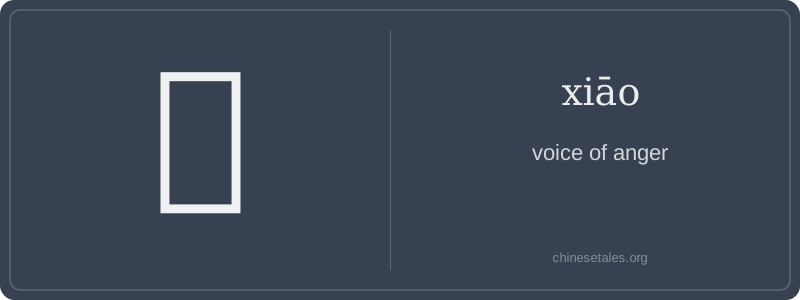
The earliest form of 呺 appears in bronze inscriptions (c. 1000 BCE) as a compound pictograph: on the left, a simplified mouth radical (口), and on the right, a stylized depiction of a person with arms raised and chest puffed — not in joy, but in visceral protest. Over centuries, the right-hand element evolved from a full human figure into the phonetic component 肖 (xiāo), which originally represented 'likeness' but here served purely for sound. The mouth radical remained constant, anchoring the character’s vocal essence. By the Han dynasty, the structure solidified into its current form: 口 + 肖 — a visual metaphor for 'the mouth producing the sound of likeness' (i.e., mimicking the sharp, recognizable timbre of outrage).
This phonosemantic evolution reflects how ancient scribes encoded emotion not through abstract symbols, but through embodied physiology: the tight jaw, flared nostrils, and compressed diaphragm required for that particular angry exhalation. In the Zuo Zhuan, it appears in descriptions of ministers rebuking corrupt lords — not with long speeches, but with a single, resonant 呺 that silenced the court. Later, in Tang poetry, it became associated with the 'voice of moral protest', especially when paired with natural imagery: 'the wind carried a 呺 across the empty terrace', implying unseen righteous fury echoing through history.
Think of 呺 (xiāo) as Chinese onomatopoeia’s angrier cousin — not the gentle 'shh' of silence, but the raw, guttural shout you’d hear in a heated opera duel or a Ming-dynasty courtroom drama. It doesn’t mean 'to shout' as a verb; it specifically names the *sound itself*: that sharp, indignant, breathy exhalation of fury — like an English 'Hmph!' crossed with a hissed 'Tch!' and a stage whisper all at once. It’s not used conversationally today; you won’t hear it in HSK textbooks or café banter.
Grammatically, 呺 is almost always a noun — rarely a verb — and appears most often in classical-style descriptions or literary mimicry: 'a 呺 of contempt', 'he let out a 呺'. You’ll see it in fixed phrases like 呺然 (xiāo rán), meaning 'with a sudden cry of indignation', where it functions like an adverbial modifier. Crucially, it’s never used alone as a command ('Shout!') — unlike 叫 (jiào) or 喊 (hǎn). Learners mistakenly try to substitute it for 'shout' in modern speech — a charming but historically inaccurate faux pas.
Culturally, 呺 carries a theatrical, almost performative weight: it evokes the stylized vocalizations of traditional Chinese opera performers, where tone, breath control, and emotional timbre matter more than literal words. It’s also deeply tied to classical restraint — the anger isn’t explosive, but tightly coiled, expressed through a single controlled expulsion of air. That’s why it’s absent from spoken Mandarin: modern usage favors verbs like 发火 (fā huǒ, 'to blow a fuse') or 生气 (shēng qì, 'to get angry'), which describe states, not sonic textures.