呸
Character Story & Explanation
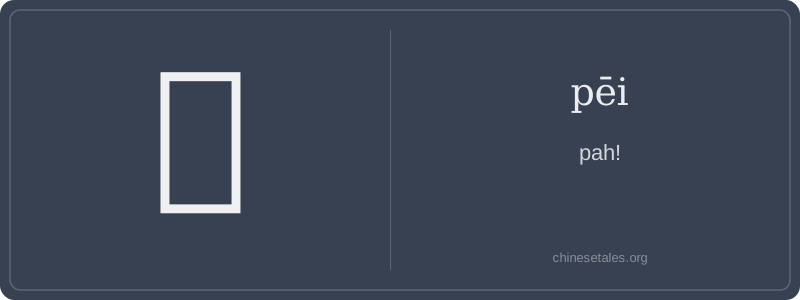
The earliest form of 呸 appears in late oracle bone inscriptions and Warring States bamboo texts as a compound pictograph: 口 (mouth) + 攵 (a variant of 攴, meaning 'to strike' or 'tap') — though crucially, the right-hand component evolved from a simplified depiction of a person spitting forcefully, not a hand striking. Over centuries, the 'spit' element stylized into the modern 匕 (bǐ), which resembles a spoon or tongue-shaped utensil — not coincidentally echoing how saliva shoots forward. By the Han dynasty, the character stabilized as 口 + 匕: mouth + projectile expulsion — a brilliantly literal visual metaphor.
This visceral origin directly shaped its meaning: in classical texts like the *Shuōwén Jiězì* (100 CE), 呸 is defined as 'tǔ yě' (to spit out), used both literally (e.g., spitting out bitter medicine) and figuratively (rejecting false doctrines). By the Ming-Qing vernacular novels, it had fully lexicalized into an interjection — notably in *Jin Ping Mei*, where characters spit 'pēi!' to scoff at hypocrisy. The visual simplicity — just eight strokes — mirrors its functional economy: no filler, no ambiguity, just mouth + action = instant dismissal.
Imagine you’re at a Beijing teahouse, and someone tells a wildly exaggerated story about catching a fish the size of a dragon. Your friend leans over, spits lightly into a brass spittoon, and says 'pēi!' — not angry, but playfully dismissive, like an audible eye-roll. That’s 呸: a sharp, guttural interjection meaning 'pah!' or 'bah!' — the linguistic equivalent of blowing air through pursed lips. It’s not a word you conjugate or decline; it’s pure vocal punctuation, spat out to reject nonsense, express contempt, mock pretension, or even tease affectionately.
Grammatically, 呸 stands alone — never modifies nouns or verbs, never takes objects. You’ll hear it as a one-word sentence ('Pēi!'), after another clause ('Tā shuō tā shì zhōngguó zuì hǎo de chúshī? Pēi!'), or doubled for extra disdain ('Pēi pēi!'). Crucially, it’s almost always spoken — rarely written in formal texts — and learners often mispronounce it as 'pāi' or 'pèi', missing its distinctive falling-rising tone (2nd tone). Also, don’t confuse it with written exclamations like 啊 or 哦: 呸 carries visceral, bodily weight — it’s rooted in the physical act of spitting.
Culturally, it’s a low-register, colloquial expression — common in northern dialects, opera, and animated speech, but avoided in polite company or official settings. Some learners overuse it trying to sound 'authentic', but native speakers deploy it sparingly, like a spice. And while it can signal light teasing among friends, deploying it toward elders or superiors is a serious faux pas — its power lies precisely in its deliberate rudeness-as-humor. Think of it as Chinese linguistic bubble wrap: satisfying to pop, but only when the package truly deserves it.