呷
Character Story & Explanation
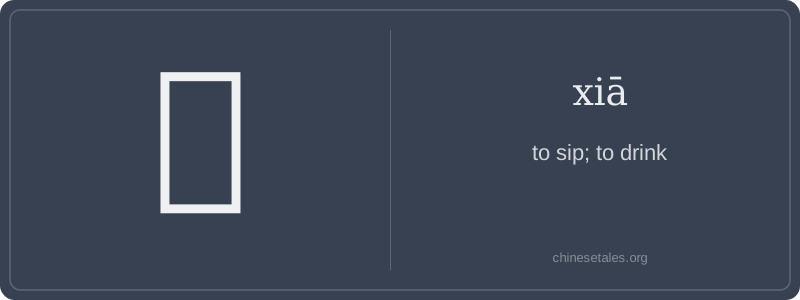
The earliest trace of 呷 isn’t in oracle bones, but in seal script (c. 3rd century BCE), where it appears as 口 + 甲 — not a pictograph of an action, but a phonosemantic compound. The 口 radical clearly signals speech or mouth-related action, while 甲 (jiǎ), originally a pictograph of a turtle shell or armor plate, served here purely for its sound — early Middle Chinese pronunciation was close to *qrap* or *krap*, which evolved into xiā. Visually, the modern form retains the clean, boxy 口 on the left and the angular 甲 (now simplified to three horizontal strokes + a hook) on the right — eight strokes total, each precise and unadorned, mirroring the crispness of a small, intentional sip.
By the Tang dynasty, 呷 appears in poetry and prose as a vivid, onomatopoeic verb — Du Fu didn’t use it, but late Ming storytellers did, capturing the gentle ‘sha’ sound of liquid passing lips. In regional usage, especially Sichuan and Hunan, 呷 absorbed local flavor: in Sichuan opera, actors ‘呷’ tea to punctuate a line; in folk songs, 呷呷 mimics the cluck of chickens or the murmur of conversation. Its visual simplicity — just mouth + ‘armor’ — ironically reflects its delicate function: a tiny, protected moment of intake, shielded from haste.
Think of 呷 (xiā) as the *soundtrack* of sipping — not just the action, but the soft, deliberate, almost musical 'ah' you make when tasting hot tea or fine wine. It’s not gulping (喝 hē), nor guzzling (灌 guàn); it’s a quiet, sensory pause: lips touching the rim, breath held, liquid drawn in gently. This character carries an intimate, almost meditative feel — like the first sip of morning tea that wakes up your whole body.
Grammatically, 呷 is almost always used as a verb in descriptive, literary, or regional contexts — especially in southern dialects like Sichuanese or Cantonese-influenced Mandarin. It’s rarely used alone; instead, it appears in reduplicated form (呷呷) for onomatopoeic effect, or with aspect particles: 呷了一口 (xiā le yì kǒu — 'took a sip'), 呷着 (xiā zhe — 'sipping while...'). Crucially, it’s *not* used for drinking water or alcohol casually — saying 我呷水 sounds oddly poetic or archaic, not natural. Learners often overuse it trying to sound ‘authentic’, but native speakers reserve it for evocative moments: storytelling, poetry, or regional dialogue.
Culturally, 呷 echoes China’s deep-rooted tea culture and oral traditions — it’s the word you’d hear in Sichuan opera narrations or old Shanghai novels describing a scholar pausing mid-thought to sip oolong. A common mistake? Confusing it with 喝 (hē) — but while 喝 is neutral and universal, 呷 is *textured*: it implies slowness, attention, even pleasure. Try replacing 呷 with 喝 in a literary sentence, and you’ll lose its whispery elegance — like swapping a harp glissando for a drumbeat.