呴
Character Story & Explanation
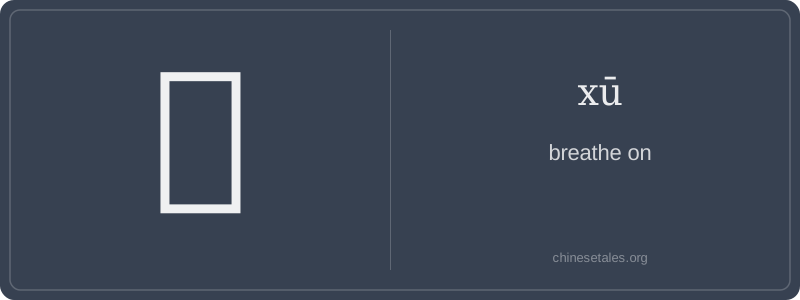
Oracle bone inscriptions show no direct precursor to 呴 — it likely emerged later, during the Warring States period, as a phonosemantic compound. Its left side 口 (kǒu) is the 'mouth' radical, anchoring it to vocal/respiratory acts. Its right side 于 (yú) is primarily phonetic (both 呴 and 于 were pronounced similarly in Old Chinese, *qʰa*), but 于 also carried connotations of 'toward', 'upon', or 'at' — subtly reinforcing the directional nature of the breath: *onto* something. Over centuries, the seal script refined the strokes, standardizing the three horizontal lines in 于 into the modern form, while 口 retained its box-like clarity.
By the Han dynasty, 呴 appeared in texts like the *Huainanzi*, describing how sages 'breathe on the frost to melt it' — metaphorically reviving what is near death. In Zhuangzi’s famous 'mutual moistening' passage (相濡以沫, xiāng rú yǐ mò), the variant phrase 呴湿濡沫 (xū shī rú mò) uses 呴 to evoke fish gasping and breathing *on each other’s damp bodies* to survive — a powerful image of fragile, reciprocal care. This cemented 呴’s semantic niche: breath as embodied compassion, not physiology — a meaning so precise it faded from spoken use but lingered in philosophical poetry.
At first glance, 呴 (xū) feels like a whisper — not loud, not forceful, but intimate and deliberate: the act of breathing *on* something or someone, often with warmth, care, or even magical intent. It’s not general 'breathing' (that’s 呼 xū or 吸 xī); it’s directed exhalation — think of a parent warming cold hands by blowing gently, or an ancient healer ‘blowing life’ into a patient. The character’s core vibe is tender agency: breath as action, not just biology.
Grammatically, 呴 is almost exclusively literary or classical. You won’t hear it in daily speech or HSK textbooks — it’s a verb that appears mainly in set phrases (like 呴呴), fixed idioms (e.g., 呴湿濡沫), or poetic/philosophical texts. It never stands alone as a modern standalone verb; you won’t say 'I 呴 the soup to cool it' — that’s 吹 (chuī). Instead, 呴 carries emotional or symbolic weight: compassion, shared vitality, or ritual breath. Learners mistakenly reach for it when they mean 'breathe out' — but this character is about *intentional, gentle, life-affirming* breath-on-contact.
Culturally, 呴 is deeply tied to Daoist and early medical thought — where breath (qì) is vital energy, and exhaling *onto* another isn’t hygiene, it’s empathy made physical. A common error is confusing its pronunciation: it’s xū (like 'shoe' without the 'sh'), *not* hū (as in 呼). Also, its radical is 口 (mouth), but unlike most mouth-related characters, it has no modern colloquial usage — making it a quiet fossil of pre-Qin linguistic sensitivity to breath as relational gesture.