呲
Character Story & Explanation
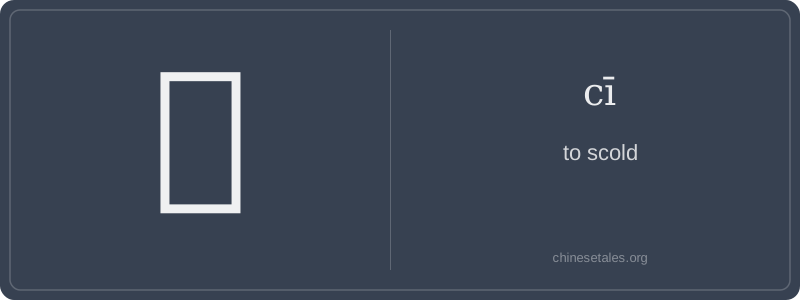
Oracle bone inscriptions show no direct precursor to 呲 — it’s a later creation, likely emerging in the Warring States or early Han period as a phonosemantic compound. Visually, it’s brilliantly economical: left side 口 (kǒu, 'mouth') anchors it as speech-related; right side 吱 (zhī), borrowed for its sound and squeaky connotation, was simplified into the modern 2-stroke 'Z' shape ( + 丶). Over centuries, the right component lost its full 'mouth + branch' structure (吱 = 口 + 支), collapsing into a tight, jagged cluster of strokes — mimicking the abrupt, grating quality of a sharp rebuke.
This character didn’t exist in classical texts like the Analects or Mencius — it’s a vernacular innovation, born from spoken language’s need to capture *how* something is said, not just *what*. By the Ming-Qing vernacular novels (e.g., Water Margin), 呲 appears in dialogue tags like '那婆子呲道' ('That old woman hissed'), revealing its role in animating voice. Its evolution mirrors Chinese linguistic history: elite classical writing favored abstract moral terms for blame (譴, 責), while everyday speech forged vivid, sensory words like 呲 — where tone, teeth, and timing do the talking.
At its core, 呲 (cī) is a vivid, onomatopoeic scolding — not quiet disapproval, but the sharp, teeth-bared *hiss* of reprimand. Think of a parent leaning in, lips parted, breath audible: 'Cī—!' It’s visceral, informal, and emotionally charged — far more biting than generic verbs like 批评 (pīpíng, 'to criticize') or 责备 (zébèi, 'to reproach'). The 'mouth' radical 口 tells you instantly this is vocal, while the right side 吱 (zhī) — itself a squeak or creak — reinforces the sound-first, expressive nature.
Grammatically, 呲 is almost always used as a verb in colloquial speech, often reduplicated for intensity: 呲呲 (cī cī) or 呲了他一顿 (cī le tā yí dùn, 'gave him a sharp tongue-lashing'). It rarely appears in formal writing or polite conversation — you’d never 呲 your boss! Learners sometimes overuse it trying to sound 'authentic', but native speakers reserve it for moments of genuine, unfiltered irritation — like scolding a dog that just chewed your shoes or a kid who dumped rice on the floor.
Culturally, 呲 carries a whiff of rough affection — it’s often used among close family or friends where emotional honesty outweighs formality. A common mistake? Confusing it with 吱 (zhī, 'squeak') or 词 (cí, 'word') due to visual similarity; also, mispronouncing it as cǐ (third tone) instead of cī (first tone) — the flat, hissing tone is essential to its meaning. Its absence from HSK reflects its status: not 'essential vocabulary', but deeply human linguistic texture.