呰
Character Story & Explanation
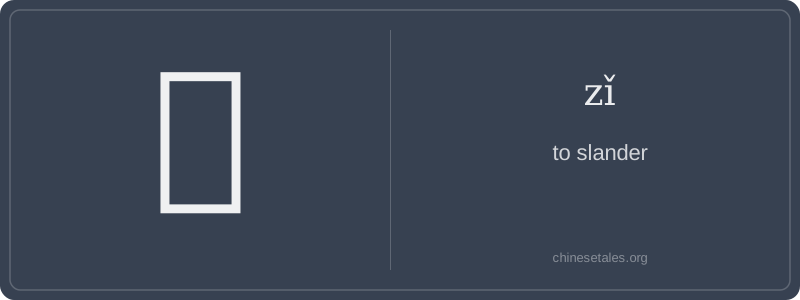
Oracle bone inscriptions show no direct precursor to 呰, but its earliest attested form appears on Warring States bamboo slips as a compound glyph: 口 (mouth) + 此 (cǐ, 'this'). The 'this' component originally depicted a foot stepping down — suggesting pointed, emphatic reference. Over centuries, 此 simplified, and the mouth radical became more prominent, visually reinforcing that this is *speech about something specific* — but speech laced with contemptuous emphasis, not neutral description.
By the Han dynasty, 呰 solidified in texts like the Shuōwén Jiězì as 'to criticize unfairly', especially targeting someone’s character with undue focus on flaws. Its usage peaked in philosophical debates — Mencius criticized rulers who '呰訾仁义' (zǐ zǐ rényì, 'slandered benevolence and righteousness'), implying ideological sabotage through distortion. The visual pairing of 口 + 此 thus evolved from 'mouth pointing at this' to 'mouth maliciously singling out this person/thing for baseless attack' — a brilliant stroke-level metaphor for targeted defamation.
At first glance, 呰 (zǐ) feels like a linguistic ghost — rare, archaic, and almost theatrical in its negativity. It doesn’t just mean 'to slander'; it carries the sting of *malicious, petty, backbiting criticism*, often whispered or muttered rather than shouted. Think less 'he criticized my policy' and more 'she hissed behind his back that he was incompetent'. That nuance is crucial: 呰 implies both moral judgment and covert delivery — the kind of speech that erodes trust quietly.
Grammatically, 呰 is almost always a verb, but it’s not used alone in modern speech. You’ll only encounter it in classical compounds or literary set phrases — never in casual conversation or HSK-level texts. It appears as the first character in disyllabic verbs like 呰訾 (zǐ zǐ), where repetition intensifies the sense of relentless, nitpicking fault-finding. Learners mistakenly try to use it like 贬 (biǎn, 'to belittle') or 毁 (huǐ, 'to ruin'), but 呰 has no colloquial life — it’s strictly a brush-and-ink word, preserved in dictionaries and classical allusions.
Culturally, 呰 reflects an ancient Chinese concern with speech ethics: Confucius warned against '巧言令色' (clever words and flattering looks), and 呰 sits squarely in that shadow — it’s the antithesis of 诚 (chéng, sincerity). A common mistake? Pronouncing it as 'cǐ' (like 此) — but the 'z' is unvoiced and sharp, like the hiss it describes. Also, don’t confuse its mouth radical (口) with passive voice — this mouth isn’t speaking truth; it’s spitting venom.