呯
Character Story & Explanation
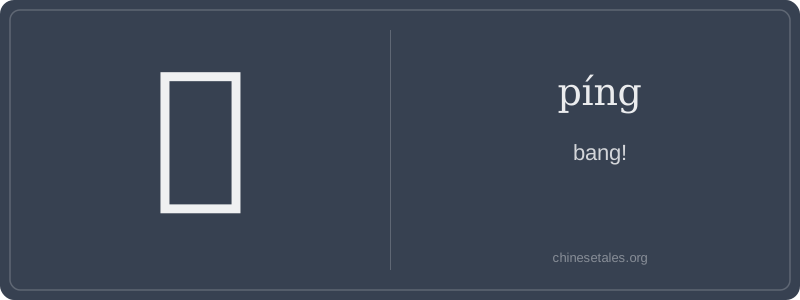
The character 呯 first appeared in print in the 1930s–40s, crafted by editors and cartoonists who needed a crisp, eye-catching sound glyph for rapid-action scenes. Visually, it merges 口 (kǒu, 'mouth' or 'sound') on the left — a universal marker for vocalized or audible phenomena — with 平 (píng) on the right, chosen purely for its pronunciation and clean, balanced strokes. There is *no* oracle bone or bronze script ancestor: it didn’t evolve — it was engineered. The left 'mouth' anchors it in the realm of human-perceived sound, while the right 'flat' provides tonal clarity and visual weight — its horizontal strokes mimic the sudden cessation of motion after impact, like a line snapping taut.
Unlike ancient characters whose meanings deepened through centuries of philosophical use, 呯’s semantic life began and remains anchored in sensory immediacy. It appears nowhere in classical texts — no Confucius, no Tang poetry — but bursts onto the page in modern vernacular fiction, film subtitles, and even early PRC propaganda posters depicting heroic gunfire ('呯!呯!呯!'). Its shape doesn’t symbolize 'flatness' — rather, the symmetry and compactness of 平 visually echoes the abrupt finality of a bang: no echo, no decay — just instant, binary silence before and after. This makes 呯 uniquely modern: not inherited, but invented to meet the rhythm of speed, violence, and spectacle in 20th-century storytelling.
呯 is not a traditional Chinese character in the classical sense — it’s a modern onomatopoeic invention, born not from oracle bones or bronze inscriptions but from 20th-century typewriters, comic books, and sound-effect-driven storytelling. Its core meaning is pure auditory impact: the sharp, sudden, percussive 'BANG!' — like a door slamming, a gun firing, or a pot dropping. Unlike ancient characters, 呯 has no semantic component or phonetic loan history; it’s a *phonogram*, designed to look and feel like an explosion in written form: the mouth radical (口) signals 'sound', while the right side (平) hints at the pronunciation píng — but crucially, it’s not *meaningfully* related to 'flat' or 'peace' (the usual sense of 平). It’s used almost exclusively as an interjection or narrative sound effect — never as a verb, noun, or modifier — and always stands alone or is embedded in descriptive prose (e.g., '呯的一声').
Learners often mistakenly treat 呯 like a regular word: trying to use it with particles (e.g., 呯了), adding it to verbs, or confusing its tone (it’s always second tone, *píng*, never fourth like 'bàng'). But 呯 doesn’t conjugate — it *explodes*. It’s frozen in sonic time. You’ll see it in novels, subtitles, manga translations, and children’s books — never in formal writing, exams, or HSK materials (hence its 'not in HSK' status). Its grammatical role is strictly that of an autonomous onomatopoeic unit: punctuating action, heightening drama, and demanding attention — like a visual drumstick strike.
Culturally, 呯 reflects how Chinese absorbs expressive needs dynamically: when existing characters (like 砰, pēng) felt too soft or literary, writers reached for new shapes. Note the subtle distinction — 砰 suggests resonance and vibration (a hollow thud), while 呯 is sharper, drier, more mechanical. Native readers instantly 'hear' this difference. A common mistake is misreading it as 平 (píng, 'flat') due to identical pronunciation and visual overlap — but there’s zero semantic connection. Think of it as linguistic graffiti: functional, vivid, and gloriously unofficial.