呬
Character Story & Explanation
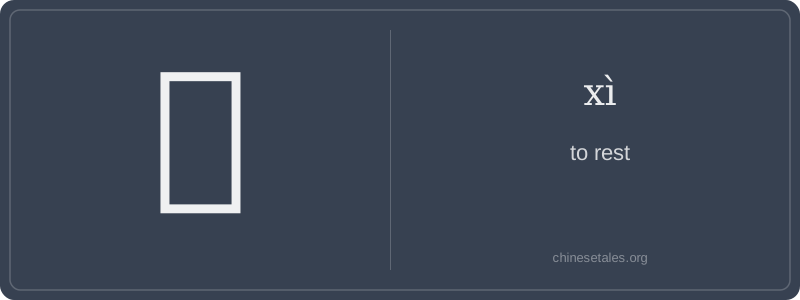
The earliest trace of 呬 appears not in oracle bones, but in Han-dynasty silk manuscripts like the Mawangdui Daoyin Tu, where it’s written with 口 (mouth) on the left and 四 (four) on the right — no simplification, no variants. The ‘four’ wasn’t numeric; it represented the *four-count rhythm* of the breath: inhale (1), hold (2), exhale (3), suspend (4). Over centuries, the seal script formalized the shape, and clerical script smoothed its curves — but crucially, the structure never changed: mouth + measured pause. Unlike most characters that evolved pictorially, 呬 was born schematic — a diagram in ink.
This wasn’t just notation — it was physiology made legible. In the Huangdi Neijing (Yellow Emperor’s Inner Canon), 呬 appears in passages describing how 'the metal element (lungs) calms when the voice sounds xì', linking phonetics to organ resonance. Later Song-dynasty qigong masters wrote that pronouncing 呬 with a soft, drawn-out 'ssss-ee' (like sighing through slightly parted lips) cools lung fire and dispels sorrow. Its form — mouth open, four strokes implying duration — literally maps the body’s pause: the moment breath becomes intention, and silence becomes medicine.
Hold on — before you reach for your dictionary, let’s clear something up: 呬 (xì) isn’t a character you’ll encounter in modern spoken Mandarin or everyday writing. It’s a fossil — a rare, archaic glyph preserved almost exclusively in Daoist qigong texts and classical medical manuscripts. Its core meaning is 'to rest' — but not the lazy kind; think of it as *intentional, breath-held stillness*, like pausing mid-inhalation to gather qi. Visually, it’s composed of 口 (mouth) + 四 (four), suggesting the mouth held open in a specific, measured count — an ancient breathing technique codified into script.
Grammatically, 呬 functions only as a verb, always in imperative or descriptive contexts related to breath regulation — never as a noun, adjective, or in compound verbs like 'rest + sleep'. You won’t say 'I 呬 for ten minutes'; instead, texts instruct '呬 — exhale slowly through the mouth', treating it as a ritualized vocalization. Learners sometimes misread it as a variant of 吸 (xī, 'to inhale') or 呼 (hū, 'to exhale'), but 呬 is neither — it’s the *pause between them*, the silent pivot point in Daoist respiration cycles.
Culturally, 呬 belongs to the 'Six Healing Sounds' (liù zì jué), where each sound corresponds to an organ and emotion: 呬 governs the lungs and releases grief. Mispronouncing it as xī or hū misses its therapeutic intent entirely. A common learner trap? Assuming it’s used conversationally — it’s not. This isn’t 'I’m resting' (我在休息); it’s 'Now perform the lung-clearing 呬'. Its rarity means even advanced learners may never need it — unless they’re studying Tang-dynasty medical scrolls or practicing authentic qigong.