呫
Character Story & Explanation
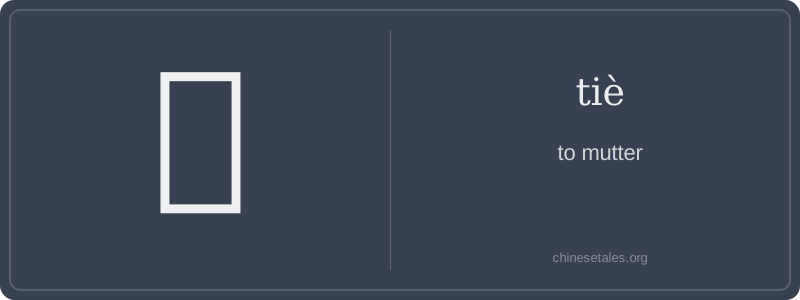
Oracle bone and bronze inscriptions show no direct precursor for 呫 — it’s a later, phono-semantic compound created during the Warring States or early Han period. Its left side 口 (kǒu, 'mouth') is the semantic radical, anchoring it firmly in speech acts. The right side 貼 (tiē, 'to stick, paste') was borrowed purely for sound (tiè), though its original meaning — something adhering closely, almost invisibly — subtly reinforces the idea of words clinging close to the lips rather than flying outward. Over centuries, 貼 was simplified graphically: the 貝 (bèi, 'cowrie shell', symbolizing value) shrank and merged with the 頰 (jiá, 'cheek') component, eventually collapsing into today’s 8-stroke form with clean, angular strokes.
This character first appeared in texts like the Shuōwén Jiězì (121 CE), defined as 'to speak softly, repeatedly, as if testing words'. In Tang poetry and Ming-Qing vernacular novels, 呫 appears in phrases like 呫嚅 (tiè rú) — describing nervous, fragmented speech — often linked to shame, secrecy, or magical incantation. Its visual economy (just 8 strokes!) belies its expressive weight: every line feels like a suppressed syllable held behind teeth.
Think of 呫 (tiè) as the quiet cousin of shouting — it’s not loud speech, but the soft, almost secretive sound of lips moving without projection: muttering, whispering under one’s breath, or even silent lip-reading. It carries a subtle sense of intimacy, hesitation, or furtiveness — like someone rehearsing words before speaking aloud, or murmuring a spell to themselves. Unlike common verbs like 说 (shuō, 'to speak') or 讲 (jiǎng, 'to talk'), 呫 is literary, rare in daily speech, and almost never used alone; it appears mainly in classical-style compounds or poetic descriptions.
Grammatically, 呫 functions as a verb (often reduplicated as 呫嚅 or 呫嗫) and nearly always pairs with other mouth-related characters to intensify the sense of hesitant, low-volume vocalization. You’ll rarely see it in isolation — no one says *‘I 呫’* — but you might read ‘他呫嚅着不敢抬头’ (He muttered softly, too timid to raise his eyes). Notice how it avoids direct objects: it doesn’t take ‘what’ is muttered, only ‘how’ — the texture of the sound matters more than the content.
Culturally, 呫 evokes a very Chinese kind of restraint: speech that hovers between thought and utterance, where silence still vibrates with intention. Learners often misread it as 叶 (yè, 'leaf') due to visual similarity — but that mistake erases the whole mouth-radical meaning! Also, don’t confuse its primary reading tiè with the rare alternate zhān (used only in ancient phonetic loan contexts, like in some dialectal glosses — irrelevant for modern learners). This character is a whisper from classical literature, not a tool for ordering dumplings.