呣
Character Story & Explanation
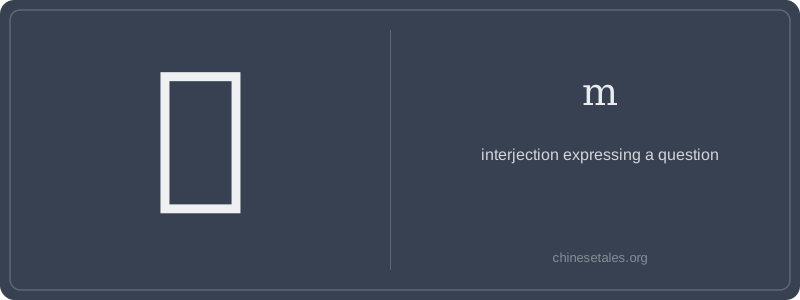
The earliest form of 呣 isn’t found in oracle bones — it’s a latecomer, born from phonetic borrowing during the late imperial period. Its shape is deliberately simple: 口 (kǒu, 'mouth') on the left, and 亩 (mǔ, 'field') on the right — but here, 亩 isn’t meaning 'field'; it’s purely a phonetic hint, approximating the m- sound. The character was crafted around the Ming–Qing transition as vernacular literature blossomed, needing a written form for the common spoken hum. Visually, it’s elegant minimalism: eight clean strokes — three for 口, five for 亩 — mirroring how effortlessly the sound slips out of the mouth.
Over time, 呣 shed any trace of its 'field' origin and became wholly vocal. Unlike ancient characters tied to ritual or agriculture, 呣 emerged from the living breath of storytellers, opera performers, and everyday dialogue. You’ll find it in Qing dynasty vernacular novels like Strange Tales from a Chinese Studio, where ghosts murmur 呣? before revealing secrets — underscoring its association with quiet wonder. Its visual calm (a small mouth beside a serene 'field' shape) mirrors its semantic role: a pause that holds space, not emptiness — the fertile silence before understanding blooms.
呣 is that soft, thoughtful hum you make when your brain is gently spinning — like a tiny question mark voiced through your nose. It’s not a full sentence; it’s the vocal equivalent of raising one eyebrow while tilting your head. Think of it as Chinese’s gentlest, most polite way to say 'Wait… what?' or 'Hmm? Really?' — never loud, never abrupt, always curious and slightly reserved. It carries warmth, hesitation, or mild disbelief, but never impatience.
Grammatically, 呣 stands alone — no subject, no verb, no particles needed. It’s an interjection, so it lives at the start (or sometimes end) of speech, often followed by silence or a clarifying question. You’ll hear it in real conversations far more than in textbooks: a teacher murmuring 呣? after a student’s unexpected answer, or a grandmother softly going 呣… before asking, 'Did you eat yet?' Crucially, it’s *not* used for yes/no questions — that’s where 吗 (ma) comes in. Learners sometimes overuse it like English 'huh?', but in Chinese, 呣 is quieter, slower, and deeply contextual.
Culturally, 呣 reflects a subtle layer of Chinese conversational etiquette: it signals active listening without judgment, inviting elaboration rather than demanding answers. Mistake it for 吗 and you’ll sound confused instead of curious; confuse it with 哦 (ò) and you’ll lose that gentle, reflective tone entirely. And though it’s absent from HSK lists, native speakers use it constantly — especially in spoken Mandarin across all ages and regions. Its absence from formal tests doesn’t mean it’s rare — it just means it’s too human, too nuanced, for standardized exams.