呡
Character Story & Explanation
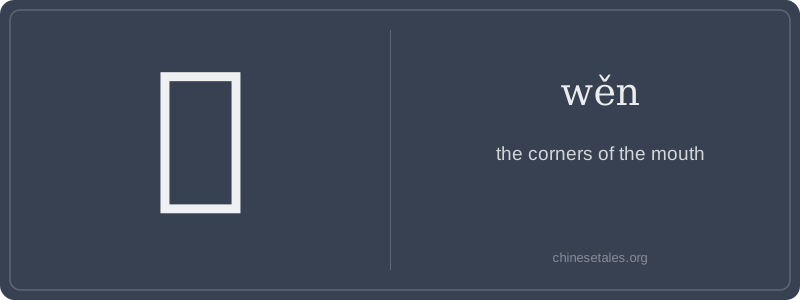
The earliest form of 呡 appears in late Warring States bamboo slips — not oracle bone script, but a refined, stylized glyph. It began as two short, upward-curving strokes bracketing a tiny horizontal line — a minimalist pictograph of the left and right mouth corners framing the oral aperture. Over centuries, scribes simplified the curves into angular hooks, added the ‘口’ (kǒu, mouth) radical at the bottom for semantic clarity, and dropped redundant lines — resulting in today’s elegant, compact shape: two small hooks above a mouth base. Crucially, it was *never* a full mouth drawing — just the flanks.
This visual restraint shaped its meaning: while ‘口’ denotes the organ, 呡 zooms in on its most mobile, emotionally charged extremities. In the 3rd-century medical classic Shanghan Lun, physicians noted ‘呡青’ (wěn qīng, bluish mouth corners) as a sign of cold stagnation. By the Song dynasty, poets used ‘呡敛’ (wěn liǎn, corners drawn inward) to suggest suppressed sorrow — showing how this tiny character became a precise brushstroke in China’s vast lexicon of embodied emotion.
Let’s be honest: 呡 (wěn) is a quiet, almost invisible character — and that’s exactly what makes it fascinating. It doesn’t mean ‘mouth’ or ‘speak’; it means *the very edges* of the mouth — those delicate, expressive corners where smiles begin, frowns tighten, or words first part. Think of it as the anatomical punctuation mark of facial expression: not the whole mouth, but its semantic hinges. Native speakers rarely use it alone; it lives in compound words or classical descriptions, lending precision to poetic or medical contexts.
Grammatically, 呡 is a noun — always modified (e.g., ‘嘴角’ is far more common than just ‘呡’), and it almost never appears in everyday speech or beginner textbooks. You’ll see it in phrases like ‘呡角’ (wěn jiǎo) meaning ‘mouth corner’, often in traditional medicine texts describing facial diagnosis — e.g., ‘呡角下垂’ (wěn jiǎo xià chuí) — ‘drooping mouth corners’, a sign of fatigue or imbalance. Unlike verbs like ‘笑’ (xiào, to smile), 呡 itself does *not* carry action — it’s purely locative and static.
Culturally, this character reflects Chinese medicine’s holistic attention to micro-signals: the corners of the mouth are read as windows into Qi flow and emotional state. Learners often misread it as ‘wěn’ meaning ‘to kiss’ (confusing it with 吻 wěn, which *does* mean ‘to kiss’) — a classic mix-up with serious tonal and semantic consequences! Remember: 呡 is *anatomy*, 吻 is *action*. And no — it’s not used in texting, slang, or modern dialogue. If you see it, you’re likely reading a Tang dynasty poem or an acupuncture manual.