呔
Character Story & Explanation
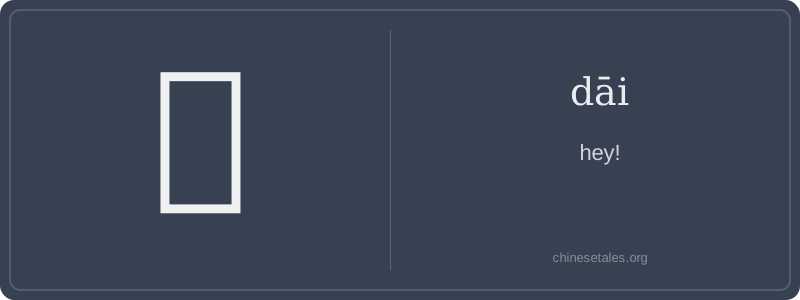
The earliest trace of 呔 isn’t in oracle bones — it’s a latecomer, born in the Ming-Qing vernacular fiction boom. Its form is brilliantly transparent: 口 (mouth radical) + 太 (tài, 'great' or 'extreme') — but here, 太 isn’t semantic; it’s purely phonetic, approximating the explosive 'dāi' sound. Visually, it’s a mouth spitting out something oversized and emphatic: the three horizontal strokes of 太 become visual exclamation points, while the 口 anchors it as vocal. No ancient pictograph existed — this is a deliberate, literati-invented 'sound-and-sign' compound, designed to look and feel like a shout frozen in ink.
Its meaning crystallized in classical vernacular novels like Journey to the West and Fengshen Yanyi, where immortal generals and Daoist masters bellow '呔!' to freeze demons mid-lunge. It wasn’t just noise — it was ritualized sonic force, akin to a mantra or talismanic syllable. The character’s simplicity (just 7 strokes) belies its weight: every stroke serves drama, not description. Even today, when a Chinese netizen types 呔 in a comment thread, they’re not speaking — they’re *performing* moral outrage or mock-heroic interruption, echoing centuries of staged righteousness.
Think of 呔 not as a word you’ll use in daily chat, but as a linguistic firecracker — a sharp, theatrical interjection that bursts onto the scene like a martial arts master shouting before a kick. Its core meaning is 'Hey!' or 'Halt!', carrying urgency, authority, and often a dash of comic or dramatic flair. It’s not a verb, noun, or adjective — it’s a pure vocative particle, almost always standing alone or at the start of a sentence, never buried mid-phrase. You’ll hear it in wuxia novels, opera, temple dramas, or even modern internet memes mimicking ancient monks: '呔!何方妖孽?' (Dāi! What demon are you?) — notice how it commands attention *before* the question begins.
Grammatically, 呔 is fossilized: it doesn’t conjugate, doesn’t take objects, and rarely appears in formal writing or speech. Learners sometimes mistakenly treat it like 啊 or 哎 — but those are flexible, emotional fillers; 呔 is rigid, performative, and culturally coded. Using it in a job interview or with your landlord? Big no. It’s reserved for role-play, satire, or stylized storytelling — like shouting 'Forsooth!' in English Shakespearean parody. Its tone is always dāi (first tone), though tǎi appears in rare regional operatic chanting (e.g., some Shaanxi clapper opera traditions), where pitch shifts emphasize dramatic tension — but that’s a specialist footnote, not a learner priority.
Culturally, 呔 is the sound of moral boundary-drawing: a Taoist priest expelling spirits, a righteous hero confronting villains, or a meme caption freezing a cartoon fox mid-scheme. Mistake it for a casual greeting, and you’ll sound like you’re summoning ghosts at brunch. Its power lies entirely in its artificiality — it’s not 'natural speech', it’s *staged speech*. That’s why it’s absent from HSK: it’s not functional language, but linguistic theater.