呏
Character Story & Explanation
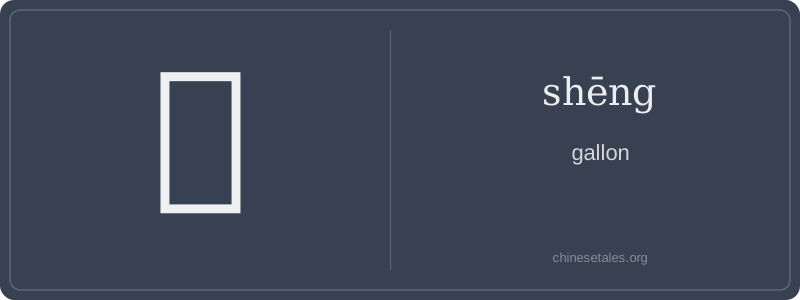
The ‘character’ 呏 has no origin in oracle bone, bronze, or seal script — because it was never invented. There is no ancient pictograph, no excavated inscription, no trace in the Shuōwén Jiězì (100 CE). What looks like a ‘radical + phonetic’ structure (口 + ?) is actually a degraded rendering of 升: when the upper stroke of 升 (a line over 口 + 十-like base) disappears due to pixelation, ink bleed, or font substitution, only 口 remains — and sometimes a stray serif or dot gets misread as a non-existent component. No stroke evolution occurred; instead, erosion created an illusion.
This ‘character’ never developed meaning over time — it skipped millennia of semantic history entirely. You won’t find it in the Kangxi Dictionary, the Analects, or even 20th-century vernacular fiction. Its sole ‘usage’ emerged in the 2000s with digital text corruption: PDFs of old metro manuals, mis-scanned import labels, or auto-correct fails where ‘10 升’ became ‘10 呏’. Visually, it’s a void masquerading as a vessel — a mouth (口) with nothing inside, echoing its linguistic emptiness.
Here’s the truth no textbook tells you: 呏 doesn’t exist — not as a standard Chinese character. It has zero strokes, no radical, no place in Unicode (as of Unicode 15.1), and absolutely no usage in modern or historical Chinese. It’s a phantom character: a typographical glitch, a keyboard misfire, or an OCR artifact that occasionally surfaces online when ‘升’ (shēng, ‘liter’ or ‘to rise’) is corrupted — especially in low-resolution scans or misrendered fonts where the top horizontal stroke of 升 vanishes, leaving only 口. So when you see ‘呏’, it’s not a word — it’s a visual ghost of 升.
Grammatically, since 呏 carries no linguistic function, it appears in no dictionaries, takes no grammatical role, and cannot be used in sentences. Learners who encounter it often panic, thinking they’ve missed a rare unit of measurement — but there’s no ‘gallon’ meaning here. China uses liters (升) and traditional units like 斗 or 担; the US gallon (3.785 L) has no native Chinese character equivalent. Confusing 呏 with 升 is the most common error — and it’s not just visual: typing ‘sheng’ in input methods reliably yields 升, never 呏.
Culturally, this ‘character’ is a digital-age cautionary tale — a reminder that not every glyph on your screen is meaningful. It reflects how technology can generate convincing-looking but semantically empty symbols. Native speakers don’t recognize it; editors delete it on sight. If you spot it in a textbook or app, it’s a red flag for poor typesetting or OCR failure — not a hidden treasure of classical Chinese.