吾
Character Story & Explanation
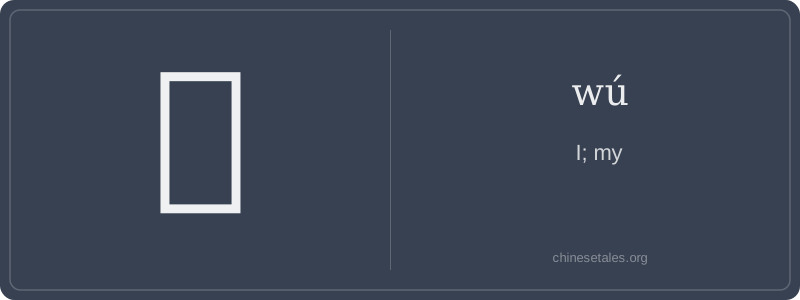
The earliest form of 吾 appears on Western Zhou bronze inscriptions as a compound: a mouth radical (口) paired with a phonetic component that looked like a hand holding a weapon or staff — possibly representing a person asserting identity through speech and authority. Over centuries, the right side simplified dramatically: the weapon morphed into 五 (wǔ, 'five'), whose shape and sound were borrowed for pronunciation, while the mouth radical remained firmly anchored on the left. By the seal script era, the seven-stroke structure we know today was locked in — 口 + 五 — visually declaring 'the speaking self' with elegant economy.
This evolution mirrors its semantic journey: from an emphatic, authoritative first-person pronoun in oracle bone and bronze texts ('I, the ruler, declare...') to a refined, introspective marker of selfhood in Confucian thought. In the Analects, Confucius uses 吾 47 times — always to express moral self-reflection or pedagogical humility, never boastful assertion. Its visual simplicity (just 7 strokes!) belies its profound role as the grammatical vessel for classical self-awareness — a mouth (口) shaped by the number five (五), perhaps echoing the Five Virtues or the five senses through which one knows the self.
Think of 吾 (wú) as Chinese Shakespeare’s ‘mine own’ — archaic, dignified, and dripping with literary gravitas. It means 'I' or 'my', but unlike the everyday 我 (wǒ), 吾 carries the weight of classical elegance: it’s the 'I' you’d hear in a Confucian dialogue or a Tang dynasty poem, not your WeChat chat. It’s never used alone as a subject in modern speech; instead, it appears in fixed expressions, proverbs, or deliberately stylized writing — like sprinkling Old English 'thou' into a TED Talk for rhetorical flair.
Grammatically, 吾 is a pronoun that can function as subject ('I') or possessive ('my'), but only in formal or literary contexts. You’ll see it in structures like 吾师 (wú shī, 'my teacher') or 吾辈 (wú bèi, 'we/us [a group of peers]'). Crucially, it cannot replace 我 in verbs like 'I eat' (我吃) — saying *吾吃 would sound like quoting a bronze inscription at brunch. Learners often overuse it trying to sound 'classical', only to unintentionally parody ancient sages.
Culturally, 吾 embodies linguistic layering: Mandarin retains this character not for daily use, but as a living fossil of Classical Chinese grammar and ethos. It appears in idioms like 吾日三省吾身 (wú rì sān xǐng wú shēn, 'I examine myself three times daily') from the Analects — a phrase still quoted by educators and calligraphers today. Mistake it for 我, and you’re not just wrong grammatically — you’ve time-traveled 2,500 years without a visa.