吽
Character Story & Explanation
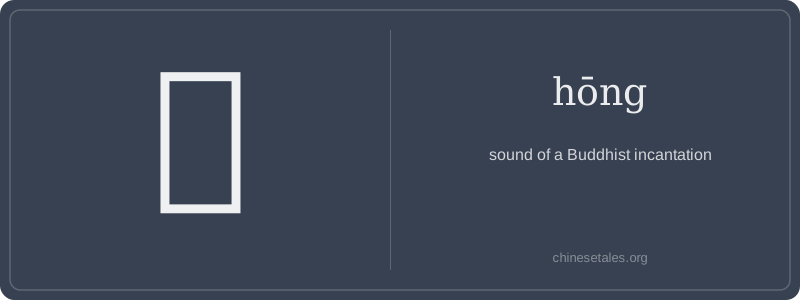
The character 吽 first appeared in late clerical script (lìshū), not oracle bone or bronze inscriptions—it’s a relatively late creation, born from the need to transcribe Sanskrit seed syllables (bīja) into Chinese characters during the peak of Buddhist translation (3rd–7th c. CE). Visually, it’s a straightforward phono-semantic compound: the left radical 口 (kǒu, ‘mouth’) signals sound-related meaning, while the right component 丑 (chǒu) serves purely as a phonetic hint—its ancient pronunciation *ŋ̊rǔʔ closely approximated the Sanskrit ‘hūṃ’ (later adapted as hōng in Middle Chinese). There are no pictographic roots: no ox, no mask—just deliberate, scholarly phonetic borrowing.
Over time, 吽 became inseparable from esoteric practice. In Tang dynasty texts like the Mahāvairocana Sūtra, it marked the culmination of mantras—symbolizing the union of wisdom and compassion, or the dissolution of illusion. Its visual simplicity (just two components) belies its heavy metaphysical load: the mouth (口) opens not to speak, but to emit primordial sound; 丑, though meaning ‘ugly’ or ‘the second Earthly Branch’, was chosen solely for its sound—not its semantics—making 吽 a rare case where form and meaning diverged intentionally. By the Song dynasty, it had crystallized as a ritual icon: carved above temple gates, painted on talismans, and chanted by monks in unison—a silent glyph that only lives when voiced.
Think of 吽 (hōng) as Chinese Buddhism’s version of a sacred ‘OM’—but with the raw, guttural power of a Tibetan throat singer or a Gregorian chant’s deepest bass note. It’s not a word you’d use to order dumplings; it’s a sonic glyph—pure vibration, representing the explosive, purifying sound of a Buddha’s command or wrathful deity’s roar. In practice, it functions almost like an onomatopoeic interjection: never a standalone verb or noun in daily speech, but always embedded in esoteric mantras (e.g., the six-syllable mantra of Avalokiteśvara), where it anchors the final syllable with thunderous resonance.
Grammatically, 吽 is a fossilized syllable—it doesn’t conjugate, decline, or take objects. You’ll never see it with aspect particles (了, 过) or measure words. Learners sometimes mistakenly treat it like a verb (‘to roar’) or try to pluralize it—but nope: it’s a liturgical unit, like ‘amen’ in Latin liturgy. Its pronunciation hōng (first tone) is strictly ritual; the alternate reading hǒu appears only in rare classical compounds meaning ‘to shout loudly’ (e.g., 吼叫), but that’s a different lexical path—think of it as a homophone cousin, not a twin.
Culturally, this character pulses with Vajrayāna energy: in Tibetan Buddhist art, deities like Hayagrīva roar 吽 to shatter ignorance. Mistaking it for everyday ‘roaring’ (like 狮子吼) misses its sacred precision—it’s not emotional noise, but enlightened sound-as-weapon. And here’s the trap: because it looks simple (just 口 + 丑), learners assume it’s basic—but it’s profoundly niche, appearing almost exclusively in sutras, temple inscriptions, and qigong chants. Skip it for HSK—but savor it as a sonic relic.