呐
Character Story & Explanation
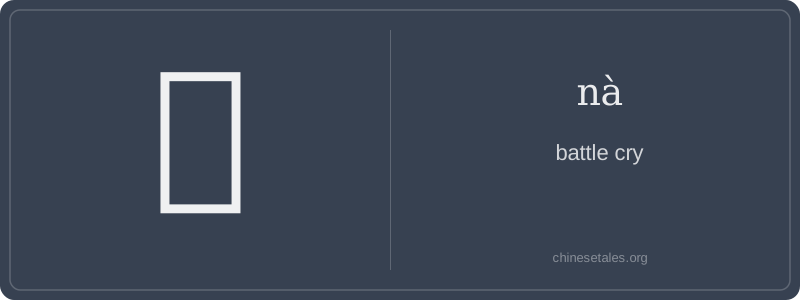
The earliest trace of 呐 appears not in oracle bones but in late Warring States bamboo slips and Han dynasty texts, where it emerges as a phonosemantic compound: 口 (kǒu, 'mouth') on the left signals sound-related meaning, while 纳 (nà, 'to receive, admit') on the right provides both pronunciation and conceptual depth — suggesting a sound so powerful it *pulls in* attention, or one emitted with full bodily 'reception' of effort. Its seven strokes evolved cleanly: first the 口 frame (3 strokes), then the four-stroke 纳 — starting with the scribe’s quick slash for the 'net' radical (罒), followed by the 'thread' (糸) simplified into two downward strokes and a final hook — mirroring how breath and tension converge in a shout.
By the Tang and Song dynasties, 呐 solidified in military and folk contexts: Du Fu’s poems allude to '呐喊震林樾' ('battle cries shaking the forest canopy'), and Ming dynasty operas prescribed precise 呐喊 rhythms for troop entrances. Crucially, its visual rhythm — compact 口 anchoring the energetic sweep of 纳 — mirrors its function: containment (the mouth) releasing explosive force (the 'receiving' of breath into roar). This duality — disciplined form unleashing unbridled spirit — makes it uniquely resonant in Chinese aesthetic thought.
At its heart, 呐 (nà) is the sound of collective human energy bursting forth — a raw, guttural battle cry, not a polite utterance. Think less 'hello' and more 'CHARGE!' — it’s visceral, rhythmic, and deeply tied to group action: soldiers surging forward, laborers heaving together on a rope, or performers summoning dramatic intensity. Unlike most 口 (mouth) radicals that denote speech or sound in neutral or functional ways (like 叫 'to call' or 吃 'to eat'), 呐 carries emotional weight and physical exertion; it’s never whispered.
Grammatically, 呐 almost never stands alone as a verb. Instead, it appears in fixed reduplicative phrases like 呐喊 (nà hǎn) — where 呐 intensifies the shouting — or as part of literary or performative interjections. You won’t say 'I呐' — but you might write '他发出一声呐喊' ('He let out a battle cry'). It’s also occasionally used in modern expressive writing for dramatic emphasis (e.g., '呐——!' as a theatrical pause before action), though this is stylistic, not conversational.
Culturally, 呐 reflects how Chinese traditionally values *coordinated resonance*: sound isn’t just communication — it’s synchronization, morale, even spiritual force. Learners often misread it as a casual filler (like 啊 or 呀), but 呐 has zero colloquial softness — using it like an interjection risks sounding unintentionally heroic or absurd. Also, beware: in some dialectal or literary contexts, it can be pronounced 'na' (light tone), functioning as a rhetorical particle similar to 呢 — but this is rare, archaic, and unrelated to the core 'battle cry' meaning.