吱
Character Story & Explanation
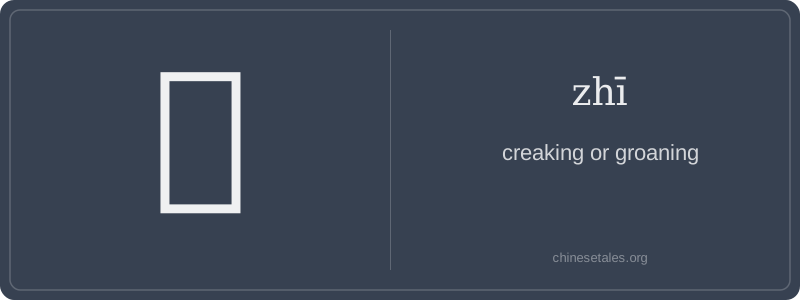
The earliest form of 吱 appears in seal script (c. 3rd century BCE), where it combines 口 (kǒu, ‘mouth’) on the left and 支 (zhī, ‘to prop up’ or ‘branch’) on the right. But don’t be fooled—the right side isn’t about support! In ancient times, 支 was used phonetically, chosen for its sound (zhī), while 口 signals that this is a vocalized, mouth-produced sound—like a sharp exhalation or involuntary cry. Over centuries, the strokes simplified: the top horizontal of 支 became a dot, the diagonal stroke sharpened, and the final horizontal stabilized—resulting in today’s clean, compact 7-stroke shape.
This character never appeared in classical philosophical texts—it was too colloquial, too visceral. Instead, it thrived in vernacular storytelling, opera scripts, and later, early 20th-century fiction, where writers needed precise auditory texture. Its visual simplicity mirrors its function: no flourish, no ambiguity—just the barest outline of a sound escaping the mouth. Interestingly, the radical 口 here doesn’t mean ‘speaking words,’ but rather ‘sound emission’—placing 吱 firmly in the realm of bodily noise, not language.
At its heart, 吱 (zhī) isn’t just a word—it’s a sonic snapshot: the sharp, thin, slightly anxious sound of something old protesting movement—wooden floorboards, rusty hinges, or a squeaky chair. Unlike English ‘creak’ (which can be low and resonant), 吱 is inherently high-pitched, abrupt, and often involuntary—evoking tension, age, or fragility. It’s an onomatopoeic character, so its meaning lives entirely in its sound and rhythm.
Grammatically, 吱 behaves like most Chinese onomatopoeia: it’s usually reduplicated (吱吱) for naturalistic effect and placed before or after a verb to modify action—e.g., 吱呀 (zhī yā) for a door groaning open, or 吱地 (zhī de) as an adverbial particle: ‘The drawer slid open 吱地一声.’ Learners often mistakenly treat it as a standalone verb (‘to creak’) or overuse it without reduplication—but native speakers almost never say *just* ‘吱’ alone in speech; it’s always part of a rhythmic, sensory phrase.
Culturally, 吱 reflects how Chinese language prioritizes acoustic texture over abstract description—sound *is* meaning. You’ll hear it in folk tales (a haunted attic door 吱呀 opening), cartoons (a startled mouse going ‘吱吱!’), even tech slang (a notification ‘吱’—playfully mimicking a tiny digital ping). A common mistake? Confusing it with similar-sounding zī characters (like 姿 or 滋), but those carry semantic weight—whereas 吱 exists purely to *vibrate* in your ear.