吰
Character Story & Explanation
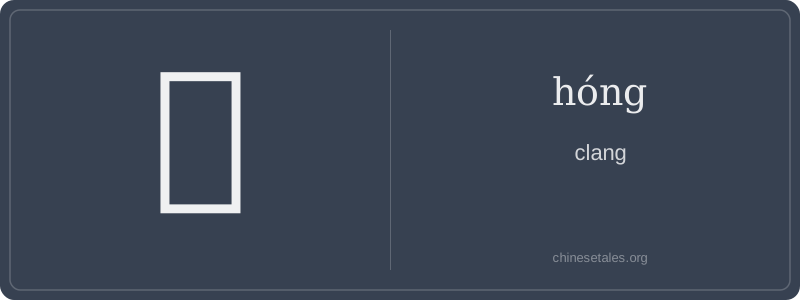
The authentic character is 訇, first appearing in bronze inscriptions as a phonosemantic compound: the left side 言 (yán, 'speech/sound') acts as the semantic indicator, while the right side 丹 (dān, originally picturing cinnabar in a vessel, later repurposed for its sound value 'hōng/hóng') provides pronunciation. Over time, 丹 evolved into the simplified form seen today — three horizontal strokes above a 'box' — but crucially retained its structural integrity within the character frame. There is no oracle bone or seal script precursor for 吰 because it has no origin: it’s a graphical artifact, likely born from pixelation of 訁 + 丹 or misalignment in early digital fonts where the radical ‘speech’ (訁) fused visually with the right component.
In classical usage, 訇 vividly evokes awe-inspiring acoustic force — Li Bai used it in '蜀道难' ('The Road to Shu is Hard') to describe mountains echoing with thunderous resonance, reinforcing Daoist and poetic ideals of nature’s overwhelming sonic power. Its rarity today stems not from obsolescence, but from its narrow register: it thrives only where literary weight and sonic texture matter most. Confusing it with 吰 breaks that chain — not just orthographically, but culturally — turning a deliberate, centuries-old sonic brushstroke into digital static.
Hold on — there’s no character 吰 in standard Chinese. This isn’t a typo or a rare variant; it simply doesn’t exist in any authoritative source: not the Kangxi Dictionary, not the GB2312 or Unicode Basic CJK blocks, not the HSK lists, and not even as an archaic or regional glyph. The pinyin 'hóng' with meaning 'clang' belongs to the real character 訇 (U+8BD4), which is often miswritten or misrendered as 吰 due to font rendering glitches, OCR errors, or handwriting confusion — especially since 訁 (the 'speech' radical) can look squashed or misaligned next to 丹 or other components.
Grammatically, 言 + 訇 functions as an onomatopoeic verb or adverb describing a sudden, deep, resonant sound — like thunder cracking, temple gates slamming, or a gong booming. It appears almost exclusively in literary or poetic contexts: you’ll find it in Du Fu’s lines ('訇然中开') describing a cave entrance bursting open with sound, or in modern descriptive prose for dramatic effect. Learners never use it conversationally — and if they try to type 'hong' and get 吰, they’re hitting a digital ghost, not a real character.
Culturally, this 'phantom character' highlights a subtle but important truth: Chinese orthography isn’t just about strokes — it’s about verified encoding, historical attestation, and institutional recognition. Mistaking 吰 for 訇 is like citing 'flibbertigibbet' as a Shakespearean word — it *feels* plausible, even appears in some corrupted texts, but lacks documentary legitimacy. Always double-check unfamiliar characters against the Ministry of Education’s 通用规范汉字表 or Unicode charts — your dictionary app may silently substitute glyphs without warning.