吮
Character Story & Explanation
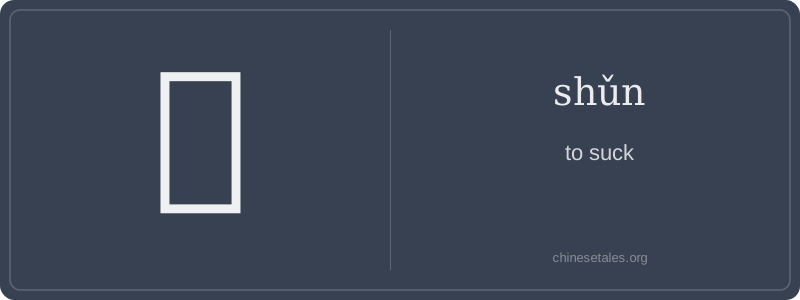
The earliest form of 吮 appears in seal script (小篆) as a combination of 口 (mouth) on the left and 允 (yǔn, originally depicting a person kneeling with hands bound, later meaning ‘to permit’) on the right — but crucially, the right side evolved from an earlier pictograph showing a tongue curling upward inside the mouth. By Han dynasty clerical script, the tongue shape simplified into the three horizontal strokes + vertical hook we see today in the right component (which looks like 允 but isn’t — it’s a phonetic-semantic fusion). Stroke-by-stroke: first the mouth radical (口), then the top dot (丶), then the three short horizontals (一 一 一), and finally the downward hook (亅) — mimicking the tongue’s curl and press against the palate.
This visual logic anchored its meaning across millennia: from oracle-bone-era depictions of infants nursing to Tang poetry describing wounded warriors 吮血 to stanch bleeding (e.g., Du Fu’s ‘warrior sucks his own blood’ imagery). In the 3rd-century medical classic 《脉经》, 吮 is prescribed for snakebite first aid — a practice still referenced in rural folklore. Its form never strayed from the mouth-tongue action, resisting abstraction; even today, when writers want primal, wordless need, they reach for 吮 — not because it’s common, but because it’s anatomically honest.
At its core, 吮 is visceral — it’s the wet, focused action of drawing liquid or air into the mouth with suction. Unlike generic ‘drink’ (喝) or ‘eat’ (吃), 吞 carries a sense of intimacy, effort, or even vulnerability: think of a baby suckling, an injured person sucking venom from a wound, or someone hungrily licking a melting popsicle. The character pulses with physical immediacy — no abstraction, no politeness. It’s not used for formal or metaphorical 'sucking' (e.g., 'sucking up to the boss' uses 巴结, not 吮); it stays stubbornly literal and bodily.
Grammatically, 吮 is almost always transitive and requires an object — you 吮 something: 吮手指 (suck fingers), 吮伤口 (suck a wound). It rarely appears in isolation; you won’t say *‘他吮了’ — it feels incomplete without what’s being sucked. Also, it’s emphatically not interchangeable with 吸 (xī, 'to inhale/suck in') — 吸 can be abstract (吸气, absorb knowledge), while 吮 is mouth-specific and tactile. Learners often misread it as 吸 due to similar stroke flow, but that swaps a tongue-and-lips action for lung-and-throat breathing — a physiological gaffe!
Culturally, 吮 appears in classical medical texts (e.g.,《本草纲目》mentions 吮疮 to draw out toxins) and modern literature to signal raw instinct — a child 吮奶, a dying soldier 吮干最后的水. It’s rarely humorous or casual; even in children’s books, it conveys tenderness or urgency. Avoid using it for machines (no ‘sucking vacuum cleaner’ — use 吸尘器), and never for figurative exploitation (‘sucking resources’ → 掠夺 or 榨取). This is human, warm, and unmistakably oral.