吭
Character Story & Explanation
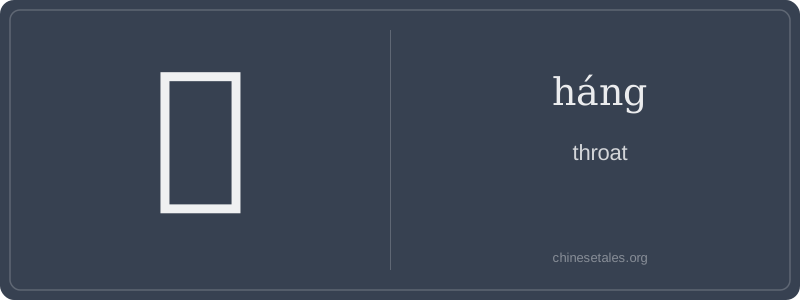
The earliest form of 吭 appears in bronze inscriptions as a combination of 口 (mouth/throat opening) and 几 (a simplified depiction of the laryngeal cartilage or vocal folds — not the furniture ‘table’!). Over time, 几 evolved into 亢 (kàng), a phonetic component meaning ‘high’ or ‘rising’, reflecting how the throat lifts during vocalization. The modern character retains 口 on the left (emphasizing its oral/respiratory nature) and 亢 on the right (7 strokes total), with the top stroke of 亢 curving like a vocal cord under tension.
This visual logic mirrors its semantic evolution: from early texts like the *Shuō Wén Jiě Zì* (121 CE), 吭 was defined as ‘the passage where sound originates’, distinguishing it from 喉 (the broader pharynx) and 咽 (the swallowing passage). In Tang dynasty poetry and Ming-Qing opera manuals, 吭 consistently denoted the *active, expressive* throat — the site of controlled resonance. Its pairing with 引 (to draw/lift) in 引吭 underscores this: you don’t just *have* a 吭 — you *engage* it deliberately, like drawing a bow.
Imagine you’re at a Beijing opera rehearsal, and the lead tenor suddenly clutches his throat mid-aria — not from pain, but to adjust his vocal placement. His master shouts, 'Yào yòng háng! Bù shì yòng hóu!' ('Use the *háng* — not just the *hóu* [general throat]!'). That’s 吭 (háng) in action: it’s not just any throat, but the *resonant, singing throat* — the precise anatomical zone where breath meets voice, especially in classical vocal training. It’s poetic, technical, and deeply embodied.
Grammatically, 吭 appears almost exclusively in fixed compounds (like 咽喉 or 引吭高歌) or in literary/medical contexts — you’ll rarely see it alone in speech. Crucially, it’s *not* used for everyday ‘throat’ (that’s 喉 hóu). Learners often mistakenly swap them, saying *háng tòng* instead of *hóu tòng* for ‘sore throat’ — a subtle error that sounds oddly operatic to native ears. Also watch the tone: háng (second tone) is the throat meaning; kēng (first tone) appears only in the verb *kēng shēng* (to speak up), where it’s unrelated to anatomy.
Culturally, 吭 carries an air of refinement and control — think of the phrase 引吭高歌 (yǐn háng gāo gē, ‘lift one’s throat to sing high’), evoking unselfconscious, powerful expression. It’s absent from HSK because it’s too specialized: not for ordering food or asking directions, but for describing a Peking opera master correcting pitch, or a doctor noting ‘háng bù zhèng cháng’ (abnormal throat resonance). Its rarity makes it a quiet badge of linguistic nuance.