吪
Character Story & Explanation
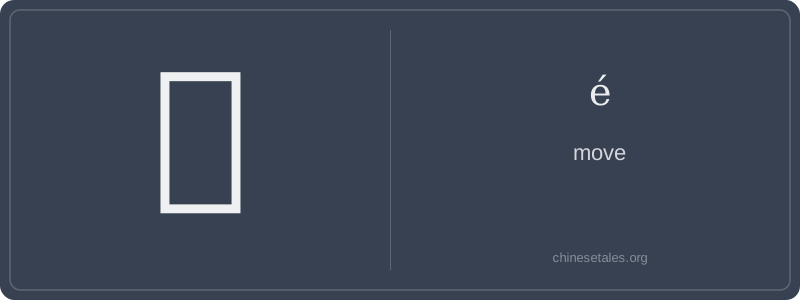
The earliest form of 吪 appears in bronze inscriptions as a composite glyph: left side was 口 (mouth), right side resembled 升 — an ancient pictograph of a rising vessel or ascending grain measure. Together, they depicted 'sound rising' or 'voice lifting upward' — suggesting vocal movement, then broadening to any gentle, upward, or rhythmic motion. Over centuries, 升 simplified into the modern 吾 (wú) component (note: this is *not* the pronoun 吾, but a phonetic loan shape), while the 口 remained, anchoring the idea of articulation and emergence.
This semantic shift from 'rising voice' to 'gentle motion' appears early in the *Shijing* (Book of Odes), where 吪 describes the trembling of reeds in wind ('萑苇淠淠,匪兕匪虎,吪然其音' — though later editions standardize as 吪). By the Han dynasty, it was firmly associated with delicate, natural movement — never forceful or mechanical. Its rarity today isn’t decline, but preservation: like a perfectly tuned antique bell, it rings only when the context demands elegance, not utility.
At first glance, 吪 (é) feels like a quiet rebel: it means 'to move' — but not the everyday kind you’d use for walking or driving. Think of it as poetic motion — the stirring of wind in bamboo, the tremor before a storm, or the subtle shift of light at dawn. It’s deeply literary, rarely heard in speech, and carries a hushed, almost ritualistic weight. You won’t find it on subway signs or menu apps — it lives in classical poetry and refined prose, where motion is felt more than seen.
Grammatically, 吪 functions as a verb, often appearing in parallel or reduplicative structures (e.g., 吪吪) to evoke rhythmic, gentle movement — like leaves fluttering or breath rising. It can also appear as a monosyllabic verb in classical-style phrases: '风吪林梢' (fēng é lín shāo), meaning 'the wind stirs the treetops.' Note: it’s never used transitively with objects like 'move a chair' — that’s 移动 or 搬. Using 吪 there would sound like quoting a Tang dynasty poet mid-sentence… unintentionally.
Culturally, 吪 is a fossil of expressive economy: one character captures *motion imbued with atmosphere*. Learners often misread it as 蛾 (é, 'moth') or 峨 (é, 'towering') due to shared pronunciation and visual similarity — but those carry no sense of motion. The biggest trap? Assuming it’s interchangeable with 动. It’s not — 动 is neutral and functional; 吪 is lyrical and evocative. If 动 is a light switch, 吪 is the slow dimming of candlelight.