吥
Character Story & Explanation
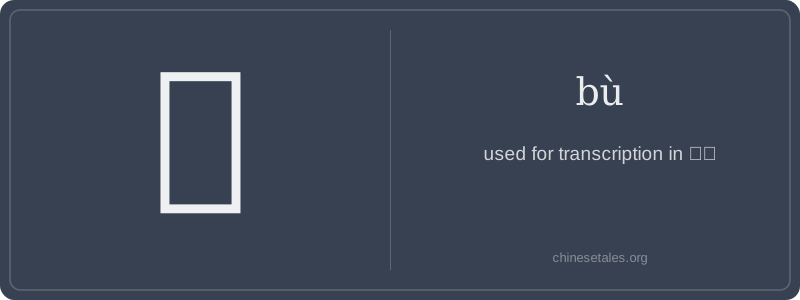
Here’s the twist: 吥 has no oracle bone or bronze inscription origin—because it wasn’t invented three millennia ago. It’s a modern orthographic improvisation, likely emerging in the late Qing or early Republican era among bilingual scribes working with Tibetan, Mongolian, or Sanskrit texts. Visually, it’s a deliberate simplification: take the common phonetic component ‘不’ (bù), then replace its bottom stroke (the dot or捺) with a horizontal line—creating a cleaner, more neutral glyph. This subtle change signals ‘this isn’t the negation 不; it’s just a sound’. No radicals, no semantic hints—just two strokes: a falling left stroke and a flat top stroke, like a tiny roof shielding a whisper.
This minimalist form reflects a profound principle in Chinese writing: when meaning isn’t needed, sound reigns. In classical dictionaries like the Kangxi Zidian, 吥 doesn’t appear—it was too specialized, too peripheral. Yet in 20th-century Tibetan-Chinese glossaries and Inner Mongolian transliteration standards, it became indispensable. Its visual emptiness—zero semantic weight—is precisely its power: it refuses to impose Chinese grammar or worldview onto foreign words. It’s linguistic humility carved into ink: ‘We hear you. We write your sound—nothing more, nothing less.’
Let’s be honest: 吥 isn’t a ‘real’ character in the classical sense—it’s a phonetic loan, born not from ancient philosophy or nature, but from the urgent need to transcribe foreign sounds into Chinese script. Pronounced bù, it carries no inherent meaning of its own; it exists purely as a sound container—like a linguistic placeholder. You’ll almost never see it alone; it appears only in tightly bound transliterations like 嗊吥 (sǎ bù), where it faithfully captures the final ‘-bu’ syllable of Tibetan or Mongolian loanwords. Think of it as Chinese’s version of using ‘X’ for an unknown variable—it’s functional, not semantic.
Grammatically, 吥 plays zero role in sentence structure. It doesn’t negate, modify verbs, or mark tense—it simply *sounds* like something else. Learners sometimes mistakenly treat it like 不 (bù, ‘not’) because of the identical pinyin and tone, but that’s a critical trap: 不 is a high-frequency grammatical powerhouse (‘I don’t go’, ‘not yet’), while 吥 is a silent guest at the banquet—present only to echo another language’s pronunciation. Confusing them won’t just sound odd—it’ll make your sentence nonsensical or even ungrammatical.
Culturally, 吥 reveals how Chinese script flexes to absorb the world: when Tibetan monks chanted ‘sang-bu’ or Mongol traders said ‘khubilai’, scribes reached for existing characters with matching sounds—even if those characters had unrelated meanings. That’s why 吥 appears in Buddhist liturgical terms and historical frontier texts, often alongside other transcription-only characters like 吒 (zhā) or 吽 (hōng). Its rarity is its charm: it’s a quiet testament to China’s centuries-long dialogue with its neighbors—not through translation, but through careful, resonant listening.