吠
Character Story & Explanation
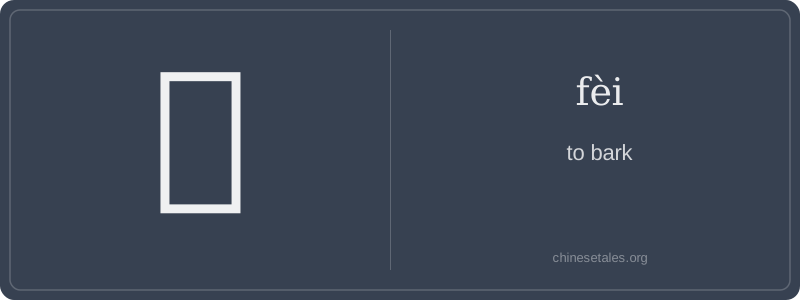
The earliest form of 吠 appears in bronze inscriptions as a combination of 口 (kǒu, ‘mouth’) and 尸 (shī, an archaic variant of 尾 wěi, ‘tail’ — but here stylized as a standing figure with bent legs). In oracle bone script, it wasn’t a dog at all — it was a mouth beside a simplified glyph representing a crouching person *with a prominent tail-like stroke*, evoking alert posture and vocal tension. Over centuries, 尸 evolved into 犬 (quǎn, ‘dog’) — a logical semantic shift — and by the seal script era, the character had stabilized as 口 + 犬: ‘mouth of the dog’. The modern form simplifies 犬 to its top-heavy, 4-stroke variant, yielding the clean 7-stroke 吠 we write today.
This visual logic — mouth + dog — locked in its meaning early: not just any animal sound, but specifically canine vocalization with intent. In the Zuo Zhuan, 吠 appears in a famous line: ‘犬不吠, 盗不止’ (‘If the dog does not bark, the thief will not cease’), linking 吠 to vigilance and moral duty. Even today, its shape whispers: this isn’t background noise — it’s a warning issued by a guardian with teeth and purpose.
Imagine walking past a traditional Beijing courtyard at dusk: suddenly, a sharp, staccato fèi! fèi! fèi! erupts — not a long howl, but short, aggressive barks, teeth bared, tail rigid. That’s 吠: it’s not just ‘dog sound’ — it’s the *intentional, vocal, alerting bark*, full of attitude and agency. Unlike generic ‘make noise’ verbs like 叫 (jiào), 吠 is reserved almost exclusively for dogs (and occasionally metaphorically for people acting dog-like: ‘barking orders’). It’s intransitive and rarely takes an object — you don’t ‘bark the door’; you 吠 *at* something (using 对 or 向), or just 吠 alone.
Grammatically, 吠 behaves like a monosyllabic verb that prefers reduplication (吠吠) for vividness or appears in literary or fixed phrases. You’ll rarely hear it in casual speech — most Mandarin speakers say 狗叫 (gǒu jiào) instead — but it shines in writing: classical poetry, news headlines about guard dogs, or satirical essays mocking shrill commentators. Learners often mispronounce it as ‘fēi’ (like 飞), but the fourth tone is crucial — it mirrors the abrupt, falling-off-the-cliff quality of a real bark.
Culturally, 吠 carries faint connotations of rudeness or uncontrolled aggression — think of the idiom 吠日 (fèi rì, ‘bark at the sun’), from a fable about a dog foolishly snapping at the sun, symbolizing futile arrogance. So while it’s neutral on the surface, context can tip it into irony or criticism. Don’t use it to describe your friendly poodle’s happy yips — save 吠 for the territorial terrier guarding the gate.