吔
Character Story & Explanation
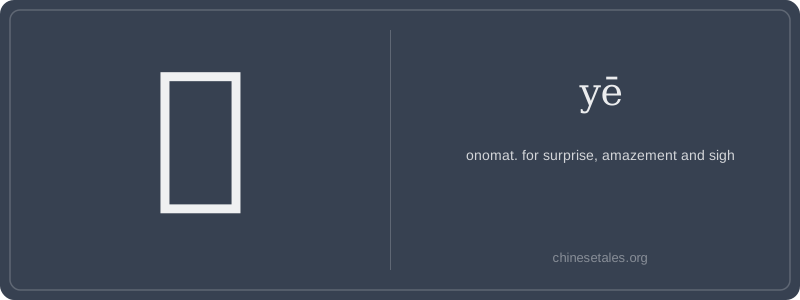
Here’s the wild part: 吔 has no ancient origin. Unlike 99% of Chinese characters, it does NOT appear in oracle bone inscriptions, bronze scripts, or the Shuōwén Jiězì. It’s a modern coinage — likely emerging in late 20th-century Mandarin dialects and exploding online in the 2010s. Visually, it’s a minimalist hybrid: the mouth radical 口 (kǒu) on the left — signaling speech or sound — fused with the phonetic component 也 (yě), which hints at pronunciation (yē) but carries no semantic link. There are no historical strokes to trace — just two clean, unadorned components slapped together like a DIY emoticon: 口 + 也 = instant vocal exclamation.
The meaning evolved precisely *because* it lacked baggage. Since it wasn’t burdened by classical usage, speakers were free to assign it the most visceral, unmediated human sound: that involuntary catch-in-the-breath when reality surprises you. No classical texts mention it — but if Confucius scrolled TikTok, he’d probably drop a 吔 when seeing a perfectly balanced stack of tofu. Its visual simplicity mirrors its function: one glance at 口+也 tells you this is 'mouth-sound' first, 'meaning' second — a character designed not to be read, but to be *felt* as vibration in the throat.
Think of 吔 as Chinese internet slang’s answer to the English 'Whoa!', 'Dang!', or that little gasp you make when your coffee is unexpectedly cold — but distilled into a single, breathy syllable. It’s not a word with semantic weight; it’s pure vocal punctuation: a spontaneous, unfiltered burst of surprise, awe, or gentle exasperation. Unlike English interjections (which often double as verbs or nouns), 吔 has zero grammatical function — it never takes objects, never conjugates, and never appears in formal writing. You’ll only hear it in speech, text messages, or subtitles for animated reactions.
Grammatically, 吔 floats freely — usually at the start of an utterance, sometimes repeated for intensity (e.g., '吔吔吔!'), and occasionally tacked onto the end like an emotional afterthought ('真的假的吔!'). It’s never followed by a comma or period in casual typing — just raw sound captured in script. Learners often mistakenly treat it like a verb ('I 吔') or try to write it in essays — a red flag! It belongs exclusively to spoken, informal, emotionally charged moments — like dropping your phone and whispering '吔…' before even checking for cracks.
Culturally, 吔 thrives in Gen-Z digital spaces: Douyin comments, WeChat voice notes, and fan fiction reaction posts. Its charm lies in its emptiness — no dictionary definition can fully pin it down because its meaning shifts with tone, pitch, and context: high-pitched = delighted shock; low and drawn-out = weary disbelief. A common mistake? Confusing it with 啊 (ā) or 呀 (ya) — but those are grammatical particles; 吔 is pure sonic graffiti. It’s not taught — it’s caught, like a reflex.