吒
Character Story & Explanation
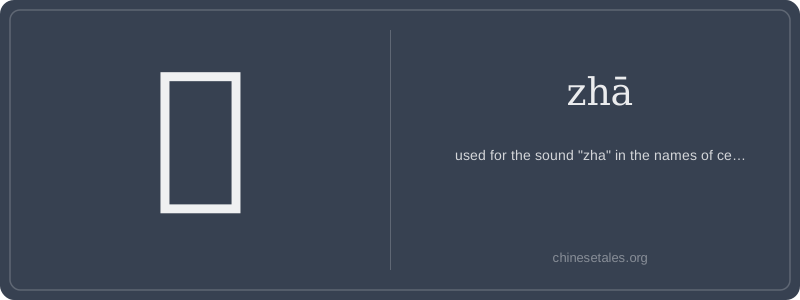
The earliest form of 吒 isn’t found in oracle bones — it’s a late creation, likely emerging during the Tang-Song transition when vernacular storytelling flourished. Its structure is deliberately minimal: 口 (mouth) + 刂 (knife radical, here stylized as the right-side stroke resembling a downward slash). Originally, the right component may have been 尸 or 乍 — but by the Ming dynasty, standardized printing carved it into today’s clean six-stroke shape: 口 (top-left square), then three strokes descending rightward — a vertical, a short diagonal, and a decisive downward hook — mimicking a shout sliced sharply from the mouth like a blade.
This visual logic — mouth + cutting force — perfectly mirrors its mythic role: Nezha’s voice doesn’t plead; it *commands*. In the Fengshen Yanyi (Investiture of the Gods), his battle cry ‘Zhā!’ precedes every transformation — a sonic catalyst. Over time, 吒 became inseparable from divine authority expressed through sound. Its lack of independent meaning isn’t a flaw — it’s design: a blank sonic canvas reserved only for gods and heroes who reshape reality with a syllable.
At first glance, 吒 (zhā) looks like a simple mouth- radical character — and it is! But don’t be fooled: this six-stroke glyph isn’t used for everyday speech or sound effects. It exists almost exclusively as a phonetic placeholder in the names of mythic warriors — most famously Nezha (Nézhā), the fiery, lotus-born deity who battles dragons and defies heaven. In Chinese, 吒 carries zero independent lexical meaning; it’s pure onomatopoeic flavor — a sharp, explosive 'zha!' that evokes clashing weapons, thunderous shouts, or divine power snapping into being. You’ll never see it alone in a dictionary definition — only tethered to a given name, like a sonic seal stamped onto legend.
Grammatically, 吒 functions solely as part of a proper noun — never as a verb, adjective, or standalone noun. Learners sometimes mistakenly treat it like a regular character and try to use it in compounds (e.g., *‘zhā shēng’ for ‘shout’), but that’s ungrammatical. It only appears after a first syllable (like Né-, Mù-, Lǐ-) and always with tone 1 (zhā). Its pronunciation is fixed — no tone sandhi, no variation — because it’s not a word, but a *name-syllable fossil*, preserved across millennia like a linguistic relic in amber.
Culturally, 吒 reveals how Chinese honors sound as identity: Nezha isn’t just ‘Nezha’ — he’s *Né-zhā*, where that final ‘zhā’ vibrates with his rebellious energy. Mistaking it for 喳 (zhā, a common chattering sound) or writing it with the wrong radical (e.g., adding 扌) breaks the mythic resonance. This character teaches a subtle truth: in Chinese, some sounds aren’t just heard — they’re *invoked*.