吏
Character Story & Explanation
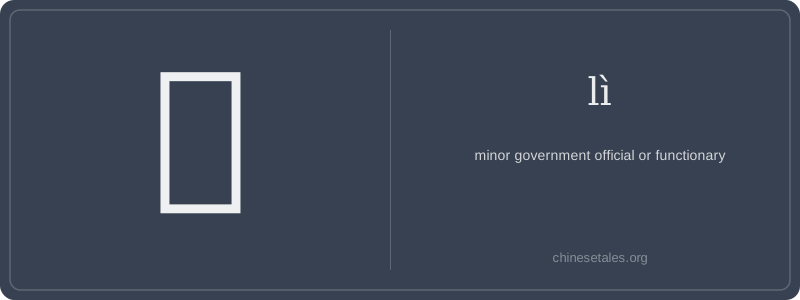
The earliest form of 吏 appears in bronze inscriptions of the Western Zhou (c. 1046–771 BCE) as a pictograph showing a hand (又) holding a writing brush (later stylized as the top stroke) above a mouth (口) — symbolizing someone who *speaks authoritatively on behalf of authority* while recording decrees. Over centuries, the hand morphed into the angular 一 and 丨 strokes atop 口, simplifying into today’s clean six-stroke structure: a single horizontal line, a vertical stroke piercing it, then 口 below — like a seal stamped over speech. The radical 口 isn’t about ‘mouth’ per se here; it represents the *spoken command made official*, the verbal order given weight through documentation.
By the Qin and Han dynasties, 吏 had crystallized into its enduring meaning: non-noble, literate functionaries who executed policy without holding noble rank. Sima Qian notes how Han emperors relied on ‘thousands of 吏’ to manage census rolls and tax ledgers — men whose names rarely appeared in histories but whose ink shaped empire. Confucius himself warned against corrupt 吏, saying their small abuses could erode trust more than a ruler’s grand failure. Visually, the character’s compactness mirrors its role: efficient, contained, authoritative yet unassuming — a seal pressed onto paper, not a throne carved in jade.
At its core, 吏 (lì) isn’t just ‘official’ — it’s the quiet hum of bureaucracy: the clerk at the county yamen, the scribe tallying grain taxes, the low-ranking but indispensable functionary who *makes the system run*. Unlike 官 (guān), which evokes high-ranking, ceremonial authority, 吏 carries a subtle whiff of paperwork, procedure, and practical power — often with a hint of moral ambiguity (think: the petty official who knows where the loopholes are). It’s a classical term, rarely used in modern spoken Mandarin outside historical drama or formal writing.
Grammatically, 吏 functions almost exclusively as a noun — never as a verb or adjective — and almost never stands alone. You’ll see it only inside compounds (like 吏治 or 吏員) or in literary contexts where brevity and gravitas matter. Learners sometimes mistakenly use it like 官 or 职员, but that’s like calling a civil service clerk ‘His Excellency’. It’s also tone-sensitive: mispronouncing lì as lǐ (third tone) instantly breaks intelligibility — there’s no common word with that tone and shape.
Culturally, 吏 reflects China’s ancient distinction between ‘scholar-officials’ (who passed exams and governed) and ‘clerical personnel’ (who handled records, seals, and logistics — often hereditary, less educated, and sometimes distrusted). In classical texts like the Records of the Grand Historian, 吏 appears alongside words like 吏道 (the ethics of clerical service) or 吏弊 (abuses by clerks), revealing deep institutional awareness. A common mistake? Assuming 吏 is neutral — it’s not. It subtly implies hierarchy, routine, and the unglamorous machinery behind imperial order.