吋
Character Story & Explanation
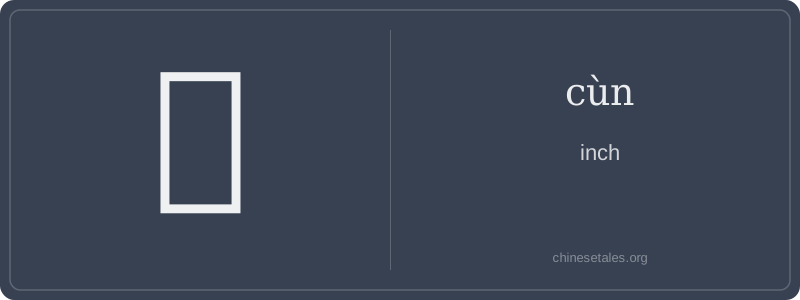
The character 吋 has no oracle bone or bronze script ancestry — it’s a modern coinage, likely designed in the early 20th century. Its form is deliberately minimalist: 口 (mouth radical) as a semantic placeholder for 'spoken sound' or 'label', combined with 十 (shí, ten) as a phonetic hint — because cùn sounds vaguely like shí in some southern dialects and shares the ‘-un’ rhyme. Visually, it’s six strokes: two horizontal lines framing 口, then 十 inside — clean, boxy, and typewriter-friendly. Unlike ancient characters that evolved organically over millennia, 吋 was engineered: no pictographic origin, no ideographic layers — just function-first design.
Its meaning emerged entirely from necessity: as Western technology flooded China, translators needed a stable, unambiguous way to render 'inch' without conflating it with the native 寸. By the 1950s, 吋 appeared in technical standards and bilingual manuals. Interestingly, its visual simplicity — a mouth-shaped frame containing 'ten' — subtly echoes how Chinese handles foreign units: enclosing the unfamiliar (the sound 'inch') within a familiar structural boundary (口), making the alien legible. No classical text references it, but its quiet omnipresence on electronics packaging tells a story of linguistic sovereignty — China didn’t adopt 'inch'; it sinicized it.
At first glance, 吋 looks like a simple loanword character — and it is! Unlike most Chinese characters rooted in ancient measurement systems (like 寸, which means 'cun', a traditional Chinese inch), 吋 is a 20th-century phonetic-semantic compound created specifically to transcribe the English word 'inch'. Its meaning isn’t conceptual or metaphorical; it’s purely functional and technical — you’ll only encounter it in contexts like screen sizes (e.g., 15.6吋 laptop), tire diameters, or imported machinery specs. It carries zero literary, poetic, or idiomatic weight — no classical texts use it, and you won’t find it in proverbs or poetry.
Grammatically, 吋 behaves like a measure word but doesn’t follow standard measure-word syntax: it attaches directly to numerals *without* 个 or other classifiers (e.g., 24吋 monitor — not *24个吋*). Crucially, it’s never used with native Chinese nouns like 书 or 桌子; it only modifies loan-context nouns (屏幕, 电视, 轮胎). Learners often mistakenly substitute it for 寸 — a serious error, since 寸 is both a traditional unit (~3.33 cm) and a standalone character in words like 尺寸 (size) or 一寸光阴 (a moment of time), while 吋 is strictly ~2.54 cm and utterly modern.
Culturally, 吋 reflects China’s pragmatic linguistic adaptation during rapid industrialization and globalization — a character invented not by scholars but by engineers and typographers in the 1930s–50s to fill a lexical gap. Its existence says something profound: Chinese doesn’t just borrow words — it builds bespoke characters to absorb foreign concepts with surgical precision. That’s why you’ll see it on product labels but never in calligraphy scrolls.