叵
Character Story & Explanation
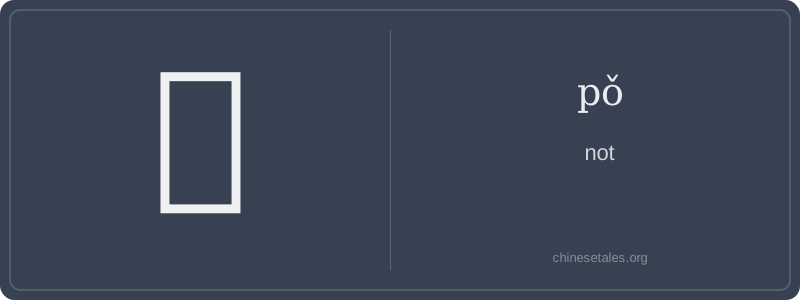
The earliest form of 叵 appears in Han dynasty clerical script, not oracle bones — it’s a deliberate simplification of 否 (fǒu, 'no'), carved by scribes who needed speed and elegance. Visually, it began as 口 (kǒu, 'mouth') with 否’s lower half — but crucially, they omitted 否’s top horizontal stroke (一), leaving just the bent hook and dot: 叵. That missing stroke isn’t accidental — it’s a graphic ‘erasure’, symbolizing negation *by removal*. Stroke by stroke: first the square 口 (3 strokes), then the downward hook (㇆) and final dot (丶) — just 5 strokes total, each one purposeful and economical.
This visual deletion became semantic destiny. By the Tang dynasty, 叵 had crystallized into a literary intensifier of impossibility — not just 'no', but 'no *in principle*', 'no *by nature*'. You’ll find it in Du Fu’s line 叵耐灵鹊多谩语 (‘Unbearable — the clever magpie speaks so falsely!’), where 叵耐 conveys moral outrage too deep for ordinary negation. Its shape — mouth sealed, logic truncated — perfectly mirrors its function: shutting down possibility at the root, not just denying an action.
Think of 叵 not as a standalone word, but as a fossilized grammatical particle — a tiny linguistic time capsule. It means 'not' or 'cannot', but only in classical and literary contexts; you’ll never hear it in daily speech or see it on subway signs. Its feel is sharp, almost defiant: it’s the 'no' that cuts across expectation, like slamming a door on possibility. Unlike modern 不 (bù) or 没 (méi), 叵 never softens — it’s always absolute, often paired with verbs of ability or permission (e.g., 叵测 — 'unfathomable').
Grammatically, 叵 is a prefix, never used alone. It only appears before monosyllabic verbs or adjectives, and *always* carries a tone of inevitability or profound limitation: 叵料 (pǒ liào, 'unexpectedly — literally “not able to foresee”) implies fate intervened; 叵耐 (pǒ nài, 'intolerable') suggests something so unbearable it defies endurance itself. Crucially, it’s never used in modern negation — saying *“叵是”* instead of *“不是”* would sound like quoting a Ming-dynasty opera script.
Culturally, 叵 is a whisper from Classical Chinese’s elegant austerity — it’s beloved in idioms and poetic titles, but vanishes in spoken Mandarin. Learners’ biggest mistake? Assuming it’s a casual synonym for 不. Using 叵 in conversation marks you instantly as either a scholar reciting Tang poetry… or someone who just misread a dictionary. Also, beware its visual trap: it looks like 口 (mouth) + 否 (no), but it’s actually 口 + 否 *without the top horizontal stroke* — a subtle erasure that mirrors its meaning: 'what the mouth cannot utter, what reason cannot allow.'