叱
Character Story & Explanation
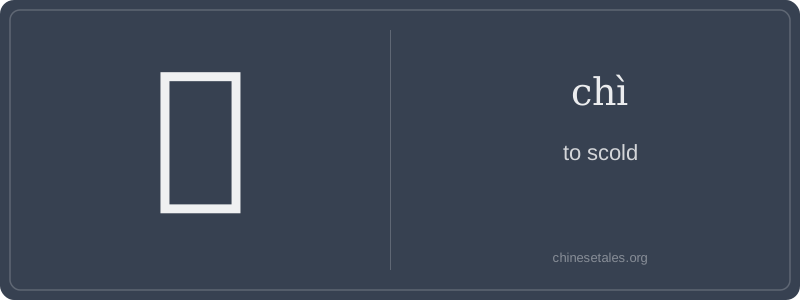
The earliest form of 叱 appears in bronze inscriptions as a combination of 口 (mouth, speech) and 七 — but not the number seven! That ‘seven’ component originally depicted a *curved whip* or *lash*, stylized into three strokes + a hook. Over centuries, the whip glyph simplified into the modern 七 shape — so 叱 literally means ‘mouth + whip’: speech as a tool of control, sharp and stinging. Its five strokes are deceptively minimal: 口 (3 strokes) plus 七 (2 strokes) — no extra flourishes, mirroring the character’s no-nonsense function.
This visual logic persisted: in the Shuōwén Jiězì (121 CE), Xu Shen defined it as ‘to shout sharply to drive away or rebuke’, citing its use in military commands. By the Tang dynasty, poets like Du Fu used 叱 to evoke moral fury — ‘叱咤风云’ (chìzhà fēngyún), meaning ‘to command wind and clouds’, metaphorically describing awe-inspiring authority. Even today, the stroke order enacts its meaning: the final downward stroke of 七 lands like a whip-crack — a visual punctuation mark of finality.
At its core, 叱 (chì) isn’t just ‘to scold’ — it’s a sharp, guttural command that cuts through noise like a whip-crack. Think of a general barking orders on the battlefield or a stern teacher silencing a rowdy class: this is not gentle correction, but authoritative, almost visceral rebuke. The character pulses with urgency and moral weight — it implies the speaker holds legitimate authority, and the listener has clearly overstepped.
Grammatically, 叱 is a transitive verb that almost always takes a direct object (e.g., 叱责 someone, 叱道 ‘shouted’, 叱退 ‘ordered to retreat’). It rarely stands alone in modern usage; you’ll almost never hear ‘他叱了’ — instead, it appears in compounds or with particles: ‘叱了一声’ (let out one sharp shout), ‘叱之曰’ (shouted at him, saying…). Learners often mistakenly use it like English ‘scold’ in casual contexts — but 叱 feels archaic, literary, or dramatically heightened. Using it to tell your roommate to ‘stop snoring’ would sound like summoning a Ming-dynasty magistrate.
Culturally, 叱 carries Confucian undertones: it’s the voice of righteous hierarchy — parent to child, ruler to subject, master to apprentice. In classical texts, it appears in moments of decisive moral intervention (e.g., Mencius criticizing rulers). A common error? Confusing it with 呵 (hē), which is softer (‘to chide gently’) or with 吆 (yāo), which is neutral ‘to call out’. Also, note: it’s almost never used in the passive voice — you don’t get ‘被叱’ in natural speech; it’s too stark, too personal.