叩
Character Story & Explanation
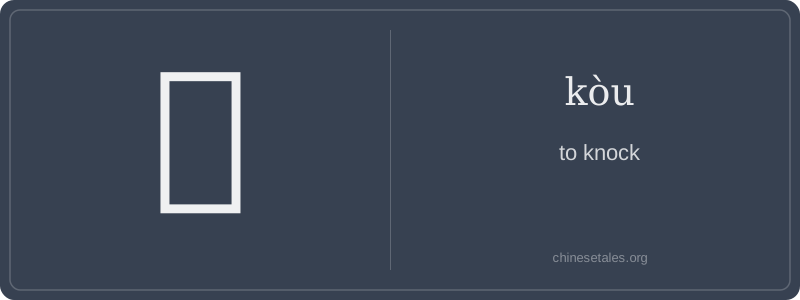
The earliest form of 叩 appears in bronze inscriptions as a pictograph combining 口 (mouth/sound) and 卩 (jié, a kneeling figure with hands bound — later simplified to 一 and 丿). Imagine a person kneeling before a gate, mouth open in a call or plea — the ‘knock’ was both sound and supplication. Over time, 卩 evolved into the right-hand component 乞 (qǐ), which looks like a bent arm reaching out — preserving the posture of humble entreaty. By the seal script era, the structure stabilized: 口 on the left (sound, voice, ritual utterance), and the stylized kneeling gesture on the right.
This visual logic anchored its semantic evolution: from literal knocking, 叩 absorbed layers of reverence — hence 叩首 (kòu shǒu), the full prostration of kowtowing, where one ‘knocks’ the forehead to the ground. In the Book of Rites, disciples are instructed to 叩而后入 (kòu ér hòu rù) — ‘knock first, then enter’ — making the character a cornerstone of ritual propriety. Even today, its shape whispers that every knock is a question posed with deference: ‘May I enter?’ ‘May I learn?’ ‘May I be heard?’
At first glance, 叩 (kòu) feels like a quiet cousin of ‘knock’ — but in Chinese, it’s never casual. Think of it as *ritual knocking*: the kind you do before entering a teacher’s study, a temple gate, or your elder’s chamber. It carries weight, respect, and intention — not the brisk ‘rap-rap’ of a modern apartment door. Its core meaning isn’t just physical contact; it’s an act of humility, a sonic bow before crossing a threshold of authority or sanctity.
Grammatically, 叩 is almost always transitive and formal — you 叩门 (kòu mén) ‘knock on the door’, 叩首 (kòu shǒu) ‘kneel and kowtow’, or 叩问 (kòu wèn) ‘humbly inquire’. You’ll rarely see it in spoken, everyday Mandarin (where 敲 qiāo dominates), but it thrives in classical allusions, literary prose, and fixed expressions. Learners often mistakenly use it where 敲 fits better — e.g., saying *wǒ kòu le yí xià mén* for ‘I knocked once on the door’ sounds oddly solemn, like you’re petitioning a magistrate.
Culturally, 叩 echoes ancient rites: Confucian texts describe disciples 叩师 (kòu shī) — literally ‘knocking at the teacher’s door’ — symbolizing earnest, respectful pursuit of knowledge. Modern writers still deploy it for poetic gravity: a poet might say 夜叩寒窗 (yè kòu hán chuāng) — ‘knocking at the frost-covered window at night’ — evoking solitude, yearning, or scholarly devotion. The trap? Assuming it’s interchangeable with 敲. It’s not — it’s the difference between tapping a friend’s shoulder and bowing deeply before a master.