叟
Character Story & Explanation
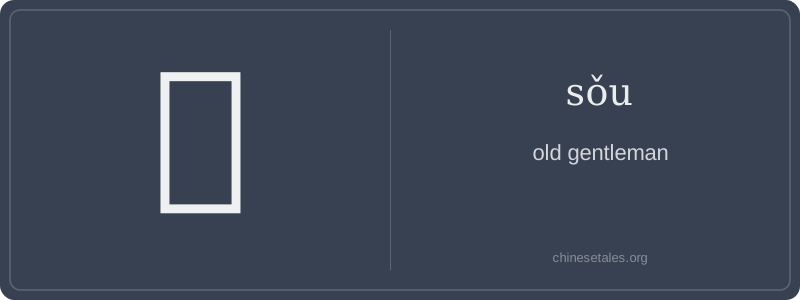
The earliest form of 叟 in oracle bone script (c. 1200 BCE) looked startlingly literal: a kneeling figure (, later simplified to 又) with a hand gripping a long, flowing beard — yes, a beard! The top part wasn’t ‘to have’ or ‘again’, but a stylized representation of long, wispy hair or whiskers dangling downward. Over centuries, the beard morphed into the upper component we see today — two short strokes above the 又 — while the kneeling posture solidified into the compact, balanced structure of modern 叟. By the small seal script era, the character had stabilized: nine strokes, radical 又 anchoring the lower half, and the ‘beard’ now abstracted into a crisp horizontal and dot.
This visual origin explains everything: 叟 isn’t about age abstractly — it’s about the *visible sign* of venerable age: the beard. In ancient China, full beards were rare before maturity and revered as marks of moral cultivation and life experience. Mencius famously wrote, ‘Shū sǒu yú jiāng’ (叟於江), describing an old fisherman by the river — not just observing him, but honoring his embodied wisdom. Even today, the character’s shape quietly echoes that ancient image: the ‘beard’ (top) resting atop the ‘hand/act of holding’ (又), as if cradling time itself.
叟 (sǒu) is a charmingly old-fashioned word for 'elderly gentleman' — think of a wise, white-bearded sage sipping tea in a quiet courtyard. It’s not just 'old man'; it carries quiet respect, even a touch of literary elegance. You’ll rarely hear it in daily speech (it’s absent from the HSK list for good reason), but it pops up in classical idioms, historical novels, and formal or poetic writing. Unlike the neutral lǎo rén (老人) or the colloquial yéye (爷爷), 叟 implies dignity, experience, and gentle authority — never condescension.
Grammatically, 叟 functions as a noun, often appearing with modifiers like yī (一) or bái fà (白发) to heighten its classical flavor: yī wèi bái fà lǎo sǒu (一位白发老叟). It never stands alone as a title (you wouldn’t say *‘Sǒu, please sit’*), nor does it take plural markers — it’s inherently singular and stylized. Learners sometimes mistakenly use it like a generic honorific (e.g., replacing xiānsheng), but that sounds jarringly archaic or even comically stiff — like addressing your barista as ‘Sir Knight’.
Culturally, 叟 appears in foundational texts like the Mencius, where ‘Yú sǒu’ (渔叟, ‘fishing elder’) symbolizes reclusive wisdom. Modern usage leans heavily on nostalgia or irony — a writer might call a tech CEO ‘yí gè chuān T-xùn de shū shēng sǒu’ (a scholar-elder in a T-shirt) to gently mock his faux-Confucian persona. Beware: pairing it with overly modern nouns creates deliberate anachronism — not error, but stylistic choice.