叕
Character Story & Explanation
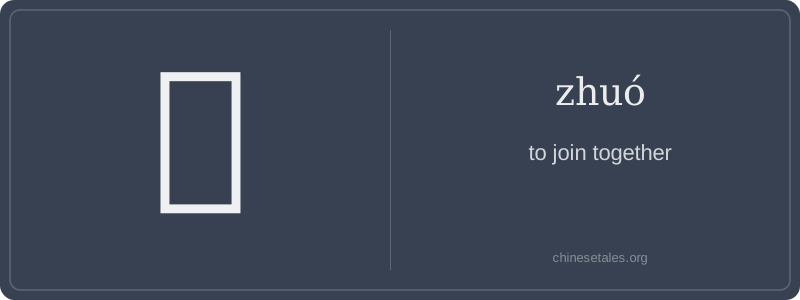
The earliest form of 叕 appears in late Shang oracle bone inscriptions as two mirrored hand glyphs ( + ), drawn side-by-side with overlapping fingers—visually echoing the act of clasp-and-lift. Each hand was rendered with three clear strokes: a wrist line, a palm curve, and an upward-tapering finger cluster. Over centuries, the left hand simplified into the standard 又 radical (a stylized right hand), while the right hand evolved into the top-right component—notice how the upper dot and angled stroke mimic a second hand’s knuckles pressing down. By the Small Seal script era, both hands had merged into a compact, balanced 8-stroke form: symmetrical, grounded, unmistakably dual.
This visual duality drove its semantic evolution. In the *Shuōwén Jiězì* (121 CE), Xu Shen defined 叕 as ‘two hands joining to lift’—emphasizing cooperative effort, not mere proximity. The *Zuo Zhuan* uses it to describe warring states forming a ‘double oath’ (叕盟), where each ruler raised a jade tablet with both hands, mirroring the character’s twin-hand structure. Even today, the shape invites tracing: your pen moves left (first hand), then arcs up-right (second hand meeting it)—a physical echo of the meaning. No wonder it’s absent from spoken Mandarin: its power lives in the eye, the hand, and the silent weight of agreement.
Imagine two hands—yours and a friend’s—reaching across a table, fingers interlacing tightly to lift a heavy tray of steaming dumplings. That moment of deliberate, synchronized joining? That’s 叕 (zhuó) in action: not just ‘together’, but *intentionally fused*, *mutually committed*. It’s the quiet power behind cooperation—not passive coexistence, but active, reciprocal binding. In classical Chinese, 叕 appears almost exclusively in formal or literary contexts to express deep, structural unity: two clans 叕盟 (joining in alliance), two rivers 叕流 (merging into one current). You won’t hear it in daily chat—it’s too elegant, too weighty for ‘Let’s grab coffee together.’
Grammatically, 叕 is a verb that *requires* two or more agents—it can’t stand alone like ‘meet’ or ‘gather’. It always implies symmetry and mutual action: A 叕 B, never just ‘A 叕’. And crucially, it’s *not* interchangeable with common synonyms like ‘hé’ (combine) or ‘lián’ (link)—those are neutral or mechanical; 叕 carries ethical gravity, echoing Confucian ideals of harmonious reciprocity. Learners often misread it as ‘yòu’ (again) because of the 又 radical—but that’s a classic trap: 叕 isn’t repetition; it’s resonance.
Culturally, 叕 whispers of ancient covenant-making—think bronze inscriptions where feudal lords clasped hands before ancestral altars, sealing oaths with this very character. Today, it survives mostly in set phrases and historical texts, giving modern readers a visceral sense of solemn, embodied unity. Skip it in HSK prep, yes—but if you spot 叕 in a Tang poem or a temple inscription, pause: you’ve just touched a linguistic handshake across three millennia.