叒
Character Story & Explanation
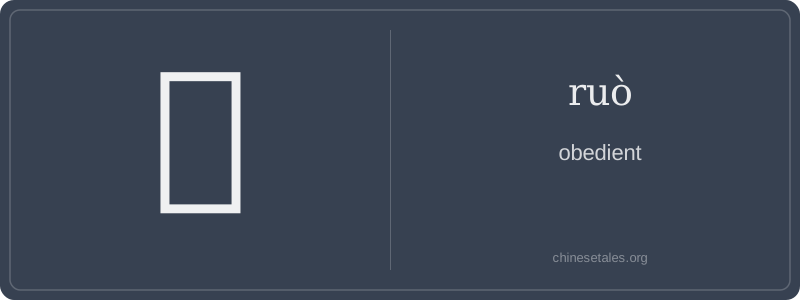
Look closely at 叒: three 'hands' stacked vertically — 又 (top), then another 又, then a third. That’s no accident. In early bronze inscriptions (c. 1000 BCE), it appeared as a triple-hand pictograph — — representing hands placed respectfully together in sequence, like a ritual gesture of yielding or receiving instruction. Over centuries, scribes streamlined it: the middle hand lost its full form, merging into a simplified stroke cluster, until by the Han dynasty it stabilized as today’s elegant 6-stroke stack — still unmistakably three hands, now stylized into rhythm and restraint.
This visual rhythm shaped its meaning: not just 'obedience', but *ordered* obedience — compliance performed with synchrony and dignity. In the Book of Rites (Lǐjì), 叒 appears in descriptions of ceremonial conduct, where disciples ‘stand 叒, gaze down, hands folded’ — their posture mirroring the character’s stacked symmetry. Even its pronunciation ruò echoes the classical word 若 (‘as if’, ‘like’), suggesting obedience that *mirrors* virtue rather than merely obeying command. The character doesn’t shout authority — it hums harmony.
Let’s be honest: 叒 (ruò) is a quiet little character — not flashy like 爱 or dramatic like 死 — but it’s got soul. Its core meaning, 'obedient' or 'compliant', isn’t about blind submission; it’s the gentle, respectful yielding you see in classical texts when a junior bows slightly before speaking to an elder — a subtle harmony, not hierarchy. Think of it as linguistic silk: soft to the touch, strong in structure.
Grammatically, 叒 is almost never used alone today. You won’t find it in modern spoken Mandarin — no one says '他很叒' — and it’s absent from HSK lists for good reason. Instead, it lives inside classical compounds and literary set phrases, often paired with words like 順 (shùn, 'to follow') or 敬 (jìng, 'to respect'). In classical syntax, it functions as an adjective or adverb describing demeanor: 叒順 (ruò shùn) means 'docile and compliant'; 叒敬 (ruò jìng) evokes 'reverent obedience'. If you try to use it standalone like an adjective ('She is 叒'), native speakers will pause — not because it’s wrong, but because it sounds like quoting a Song dynasty essay.
Culturally, 叒 carries quiet Confucian weight: it’s not about fear or force, but about relational grace — the kind of obedience that flows from care, not coercion. Learners often misread its radical 又 ('again') as implying repetition, but here it’s purely phonetic — the sound clue, not the meaning clue. And beware: confusing it with 若 (ruò, 'if' or 'like') is the #1 trap — they look alike, sound identical, but 若 is ubiquitous while 叒 is a museum piece. Use 叒 only when you’re channeling your inner scholar — or writing calligraphy on rice paper.