叁
Character Story & Explanation
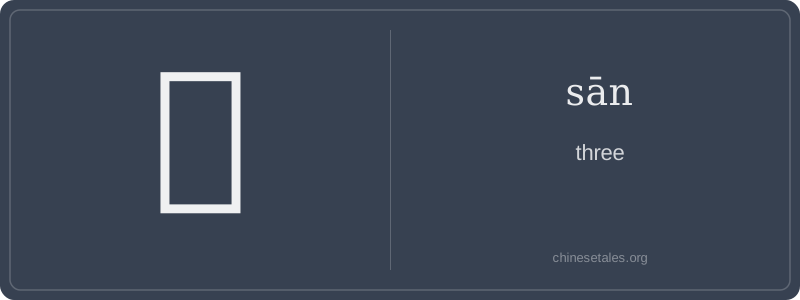
The earliest form of 'three' was the oracle bone character 三 — three horizontal lines, pure and minimal. But 叁 evolved much later, around the Han dynasty, as a deliberate elaboration: starting from the phonetic component 士 (shì, 'scholar'), then adding the radical 厶 (sī, a curled enclosure symbolizing 'private' or 'sealed'), and finally incorporating two extra strokes to create its distinctive eight-stroke silhouette. Visually, it’s a fortress built around the idea of 'three' — thick strokes, closed loops, and angular precision, unlike the open, flowing 三.
This wasn’t artistic whim — it was bureaucratic necessity. By the Tang dynasty, financial records mandated 'capital numerals' to prevent forgery, and 叁 became codified in the 《唐六典》 (Tang Administrative Code). Its shape echoes classical seal script aesthetics: the top resembles a stylized 'crown' (indicating authority), the middle evokes a locked gate (security), and the bottom ‘厶’ radical subtly signals 'what is sealed and non-transferable'. Unlike 三 — which appears in the Analects and Dao De Jing — 叁 first surfaces in Song-dynasty tax ledgers, where precision trumped poetry.
Imagine you’re at a traditional Chinese bank in Shanghai, signing a loan agreement. The clerk carefully writes 叁 — not 三 — beside the amount ¥30,000. Why? Because 叁 is the *financially secure* version of 'three': a complex, anti-fraud character used exclusively in formal documents, checks, and contracts to prevent tampering. It’s not spoken aloud in daily life (you’ll always say sān for 'three'), nor used in counting, texting, or speech — it exists purely on paper, like a linguistic bouncer keeping counterfeiters out.
Grammatically, 叁 functions only as a numeral in highly constrained contexts: never as an adjective ('three apples'), never with measure words ('three books'), and never in compounds like 三月 (March) or 三角形 (triangle). You’ll only see it after currency symbols (¥叁万), in legal clauses ('叁方协议' — tripartite agreement), or classical-style inscriptions. Mistake it for 三? Your contract might be legally void — or worse, instantly suspicious to a native reviewer.
Culturally, 叁 belongs to the 'capital numerals' system (壹、贰、叁、肆…), designed during the Ming dynasty to thwart fraudsters who could easily alter simple strokes (e.g., turning 三 into 五 or 二). Learners often wrongly assume it’s an archaic synonym for 三 — but it’s not archaic; it’s hyper-modern in function, actively maintained in banking software and government forms. Using it casually (e.g., '我有叁个朋友') sounds bizarre, like writing 'THREE' in all caps mid-sentence in English — technically correct, but socially jarring.